
Your oral health is a critical indicator of your overall well-being. Recent medical research links the condition of your mouth to systemic health issues ranging from cardiovascular disease to diabetes. Yet for many patients in the USA navigating the complex terminology of clinical dentistry can feel overwhelming. You might be dealing with a sudden toothache. You might be planning a complete cosmetic makeover. Or you may simply be confused by an insurance explanation of benefits. You need a clear and authoritative roadmap to understand what is happening inside your mouth.
Table of Contents
This comprehensive guide to the different types of dental procedures explained covers the entire spectrum of modern dentistry. We will move beyond simple definitions to explore the clinical necessity. the step-by-step processes. and the long-term value of these treatments. From routine maintenance to complex surgical reconstruction. every intervention serves a specific purpose in preserving your biological structures.
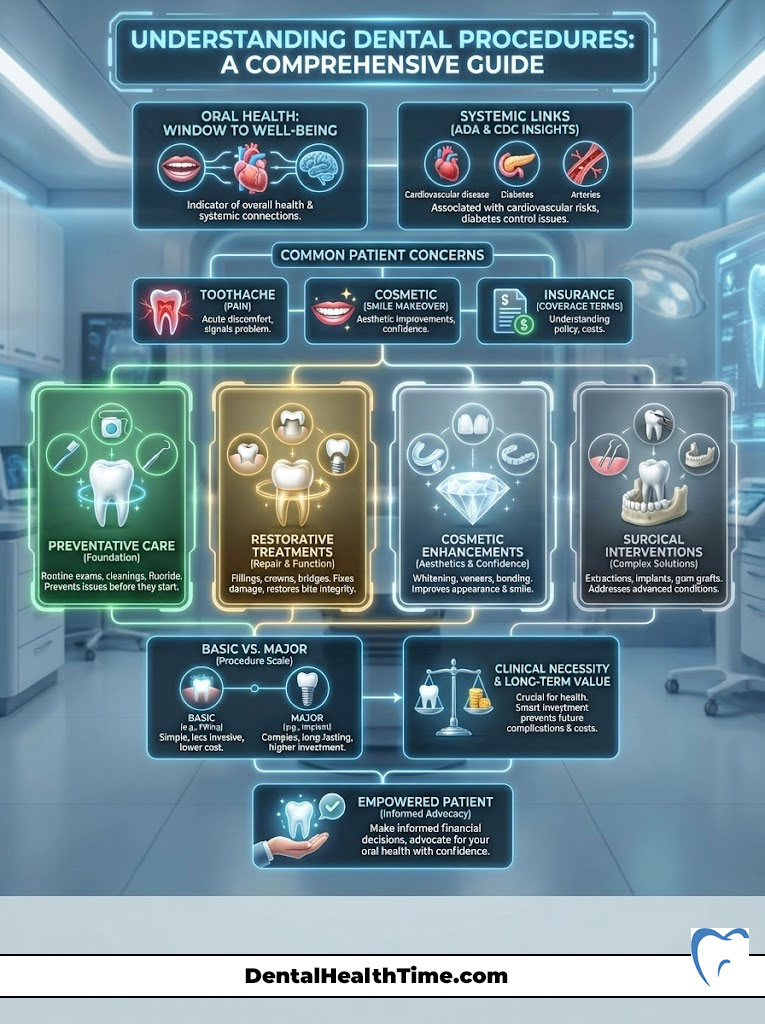
We will break down these interventions into four primary pillars: Preventative. Restorative. Cosmetic. and Surgical. We will back these explanations with data from the American Dental Association (ADA) and the Centers for Disease Control and Prevention (CDC). By understanding the distinction between a “basic” filling and “major” dental implants. you can make informed financial decisions. You can maximize your insurance benefits. Most importantly. you can advocate for the oral health of yourself and your family.
Understanding the Classification of Dental Procedures and Care

How Dental Professionals Categorize Treatments
Dentistry is not a monolith. It is a highly organized field where treatments are categorized based on their urgency. their invasiveness. and their intended outcome. This categorization is vital for understanding your treatment plan. It is also the framework used by dental insurance (Basic/Major) providers to determine what they will pay for.
The four main pillars of dental care are distinct yet interconnected:
- Preventative Dentistry/Care: These are non-invasive procedures designed to maintain health and arrest disease before it starts. They are the most cost-effective form of healthcare.
- Restorative Dentistry Types: These interventions repair damage caused by decay. trauma. or wear. The goal is to return the tooth to full function.
- Cosmetic Dental Treatments: These procedures focus primarily on aesthetics. improving the color. shape. and alignment of teeth.
- Oral Surgery and Specialized Care: These are invasive techniques dealing with deep tissue. bone. and complex structural issues.
The Role of the General Dentist vs. Dental Specialists
Most patients begin their journey at a general dentist/dental office. These practitioners are the primary care providers for your mouth. They diagnose conditions. manage overall care. and perform the vast majority of common dental procedures like fillings. crowns. and cleanings.
However. the complexity of the human mouth often requires specialized expertise.
- Endodontists: These specialists focus exclusively on the soft inner tissue of the tooth. They perform advanced root canal (Endodontic treatment) therapies to save teeth that would otherwise be extracted.
- Periodontists: These are the experts in the supporting structures of the teeth. They treat periodontal disease/gum disease and perform implant surgeries.
- Oral and Maxillofacial Surgeons: They handle complex tooth extraction. jaw reconstruction. and trauma repair.
- Orthodontists: They specialize in the alignment of teeth and jaws using braces or aligners.
Preventative Dentistry Procedures and Routine Maintenance
Professional Dental Cleaning and Prophylaxis Protocols
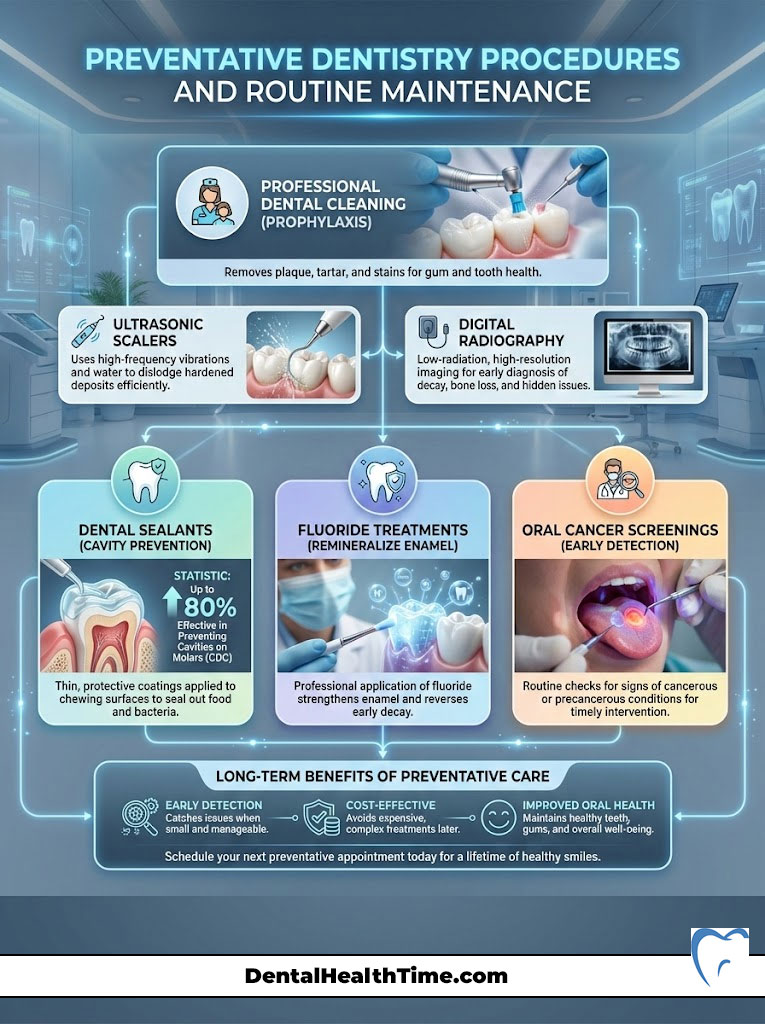
A professional dental cleaning. clinically known as prophylaxis. is the foundation of preventative dentistry/care. Many patients view this as a simple cosmetic polish. but it is a rigorous medical procedure. Even with diligent brushing and flossing at home. plaque eventually mineralizes into calculus (tartar). This substance cements itself to the teeth and cannot be removed with a toothbrush.
During a professional cleaning. a dental hygienist uses specialized instruments like ultrasonic scalers. These tools use high-frequency vibrations and water flow to fracture and flush away tartar deposits from above and below the gumline. This process is essential for preventing gingivitis. It also creates a clean surface for the dentist to examine the soft tissues for signs of infection or abnormalities.
Diagnostic Services and Advanced Digital Radiography
You cannot treat what you cannot see. Digital radiography (X-rays) has revolutionized dental diagnostics. Modern digital sensors reduce radiation exposure by up to 90% compared to traditional film X-rays. making them safe for routine use.
These images are critical for detecting issues that are invisible to the naked eye during a visual exam:
- Interproximal Decay: Cavities that form between tight contacts of teeth.
- Bone Loss: The hallmark sign of advanced periodontal disease/gum disease.
- Periapical Abscesses: Infections forming at the very tip of the tooth root.
- Developmental Anomalies: Issues with jaw growth or impacted teeth.
Dental Sealants and Fluoride Treatments for Cavity Prevention
Preventative dentistry/care utilizes chemical and physical barriers to stop decay. Dental sealants are thin plastic coatings applied to the chewing surfaces of the back molars. These teeth have deep grooves and fissures where toothbrush bristles cannot reach. The sealant flows into these grooves and hardens. creating a smooth shield that bacteria cannot penetrate. The CDC reports that dental sealants prevent 80% of cavities in the permanent molars of school-age children.
Fluoride treatments are another powerful tool. Fluoride is a naturally occurring mineral that has the unique ability to remineralize tooth enamel. When applied in high concentrations at the dentist/dental office. it strengthens the crystalline structure of the teeth. This makes them more resistant to the acid attacks caused by sugar and bacteria. It can essentially reverse early stage decay before a cavity ever forms.
Comprehensive Oral Cancer Screenings
Oral cancer is a serious condition with a high mortality rate if not caught early. During your routine examination. your dentist performs an oral cancer screening. This involves a visual and tactile inspection of the lips. tongue. throat. gums. and the floor of the mouth. The dentist looks for unusual sores. red or white patches. or lumps. This quick and painless check is a life-saving component of common dental procedures that is often overlooked by patients.
Restorative Dentistry Types for Repairing Tooth Structure
Cavity Fillings and Direct Restoration Techniques
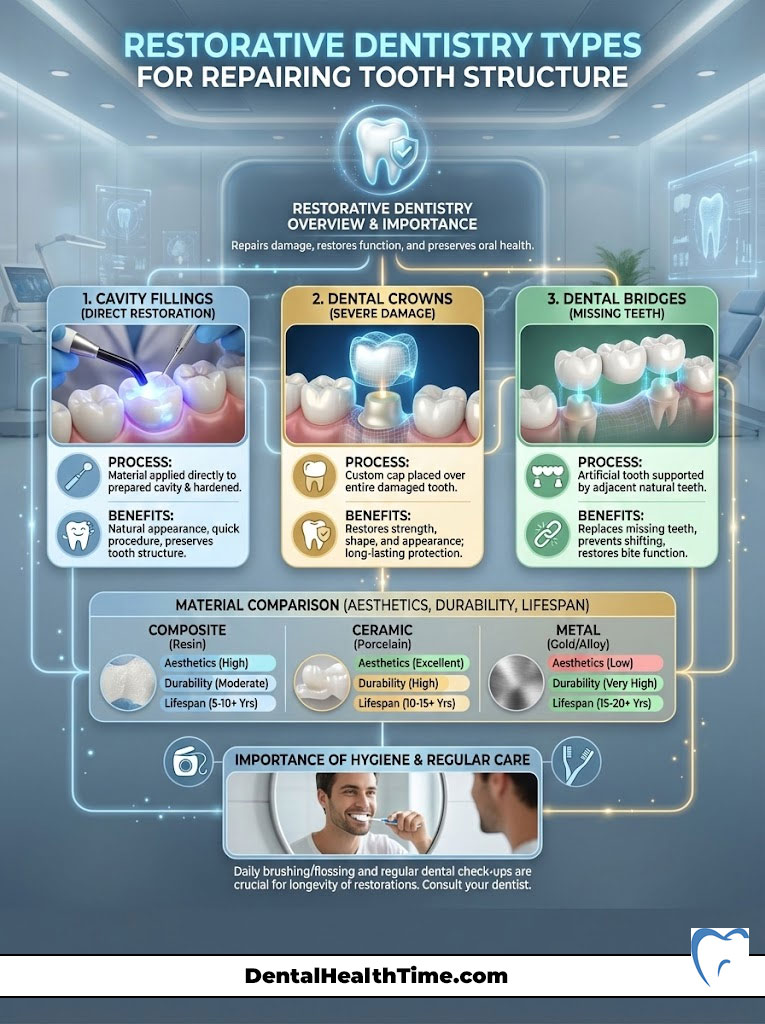
When bacteria penetrate the enamel. they create a permanent hole known as a cavity. Restorative dentistry aims to halt this progression and repair the structure. Cavity fillings are the most frequently performed procedure in the world.
The process involves local anesthesia to numb the area. followed by the removal of the decayed tooth structure using a dental handpiece. The void is then cleaned and filled.
- Amalgam (Silver) Fillings: These are made from a mixture of metals including silver. tin. copper. and mercury. They are incredibly durable and cost-effective. making them a common choice for back molars that endure heavy chewing forces.
- Composite Resin Fillings: This is a tooth-colored mixture of plastic and glass. It bonds directly to the tooth structure. which allows the dentist to preserve more natural tooth than with amalgam. It is the preferred choice for visible teeth due to its aesthetic qualities.
Dental Crowns and Indirect Restorations
Sometimes a tooth is too damaged for a simple filling. This often happens after a severe fracture. a large area of decay. or a root canal (Endodontic treatment). In these cases. a dental crown is required.
A crown is a custom-made cap that covers the entire visible portion of the tooth down to the gumline. It restores the tooth’s original shape. size. and strength.
- Preparation: The dentist must reduce the size of the natural tooth to make room for the crown material.
- Impression: A digital scan or physical mold is taken to ensure the crown fits your bite perfectly.
- Placement: The crown is cemented permanently into place. safeguarding the underlying structure from fracturing under pressure.
Restorative Material Comparison Table
Choosing the right material for your restoration is a critical decision that balances aesthetics. durability. and cost.
| Material Type | Aesthetic Appeal | Durability | Average Lifespan | Best Clinical Use Case |
| Composite Resin | High (Matches tooth color) | Moderate | 5 to 7 years | Front teeth; small to medium cavities |
| Amalgam (Silver) | Low (Visible dark metal) | High | 10 to 15+ years | Back molars; heavy chewing forces |
| Zirconia | High (Translucent options) | Very High | 15+ years | Crowns; patients who grind/clench |
| Gold Alloy | Low (Gold color) | Extremely High | 20+ years | Back molars; areas not visible |
| Porcelain-Fused-Metal | Moderate (Opaque center) | High | 10 to 15 years | Crowns and Bridges; structural support |
Dental Bridges for Replacing Missing Teeth
Before implants became the standard. dental bridges were the primary method for replacing a missing tooth. A bridge utilizes the healthy teeth on either side of a gap as anchors. These anchor teeth (abutments) are shaved down and crowned. A false ceramic tooth (pontic) is fused between them. bridging the gap.
While effective at restoring the bite. bridges present hygiene challenges. Patients must thread floss underneath the false tooth daily to prevent decay on the anchor teeth. Despite this. they remain a viable option for patients who are not candidates for surgery.
Advanced Tooth Replacement Options and Dental Implants
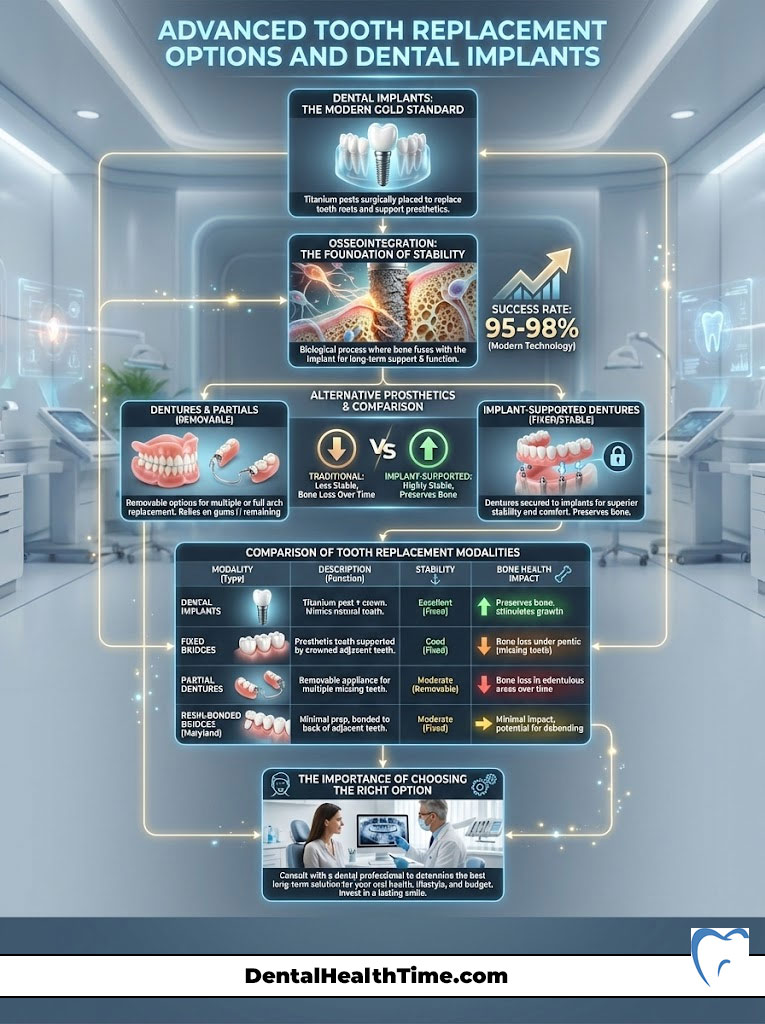
Dental Implants and Osseointegration
Dental implants represent the most significant advancement in modern restorative dentistry. Unlike bridges or dentures which sit on top of the gums. implants replace the actual root of the tooth.
The procedure relies on a biological process called osseointegration.
- Placement: A biocompatible titanium post is surgically inserted into the jawbone.
- Healing: Over 3 to 6 months. the bone cells grow into the microscopic grooves of the titanium. locking it in place.
- Restoration: Once healed. an abutment and a custom crown are attached.
Modern dental implants boast a success rate of 95% to 98%. They are the only tooth replacement option that stimulates the jawbone. preventing the bone loss that typically follows tooth extraction.
Dentures and Partial Prosthetics
For patients missing multiple teeth or an entire arch. dentures provide a functional solution.
- Complete Dentures: These replace all teeth in the upper or lower jaw. They rely on suction and the anatomy of the mouth for retention.
- Partial Dentures: These are used when some healthy teeth remain. They consist of replacement teeth attached to a gum-colored base connected by a metal or plastic framework. They clip onto the natural teeth for stability.
While traditional dentures are more affordable than implants. they can be unstable. Many patients now opt for implant-supported dentures. which snap onto titanium posts for a secure fit that does not slip while eating or speaking.
Comparison of Tooth Replacement Modalities
| Procedure | Surgical Requirement | Healing Time | Relative Cost | Long-Term Bone Health |
| Dental Implant | Yes (Invasive) | 3 to 6 months | High | Preserves and stimulates jawbone |
| Fixed Bridge | No (Crown prep only) | 2 to 3 weeks | Moderate | Slight bone resorption over time |
| Partial Denture | No | Immediate | Low | Continual bone loss due to pressure |
| Resin-Bonded Bridge | Minimal | Immediate | Low-Moderate | Minimal support; aesthetic only |
Cosmetic Dental Treatments for Aesthetic Enhancement

Professional Teeth Whitening Systems
Cosmetic dental treatments often begin with whitening. This is the least invasive way to improve a smile. Professional systems use high-concentration peroxide gels that are far stronger than over-the-counter strips.
The peroxide penetrates the porous enamel rods to oxidize and break down deep pigment molecules.
- In-Office Whitening: Utilizes a light-activated gel for dramatic results in about an hour.
- Take-Home Trays: Custom-molded trays allow you to apply professional gel at home over a period of two weeks.
- Safety: When supervised by a dentist/dental office. whitening is safe and does not damage the enamel structure.
Porcelain Veneers for Smile Makeovers
For teeth that are chipped. gapped. or severely discolored. porcelain veneers offer a comprehensive solution. A veneer is a wafer-thin shell of medical-grade ceramic that is bonded to the front surface of the tooth.
The process involves removing a small amount of enamel (usually less than a millimeter) to accommodate the veneer. This ensures the final result does not look bulky. Porcelain veneers cost is an investment. but they are highly resistant to staining from coffee or wine. making them a long-lasting cosmetic solution.
Dental Bonding and Gum Contouring
Dental bonding is a more conservative alternative to veneers. The dentist applies a tooth-colored composite resin to the tooth and sculpts it to fix chips or close gaps. It is then hardened with a curing light. While less expensive than veneers. bonding is more porous and can stain over time.
Gum contouring is another cosmetic procedure used to treat a “gummy smile.” specialized lasers are used to remove excess gum tissue. exposing more of the natural tooth crown for a balanced and symmetrical appearance.
Oral Surgery and Specialized Interventions
Endodontic Treatment and Root Canal Therapy
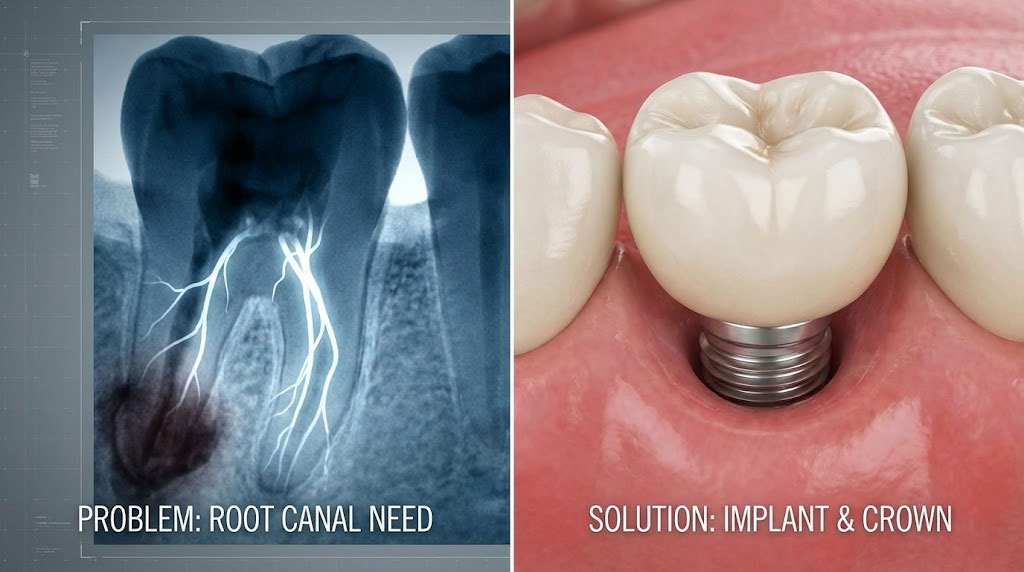
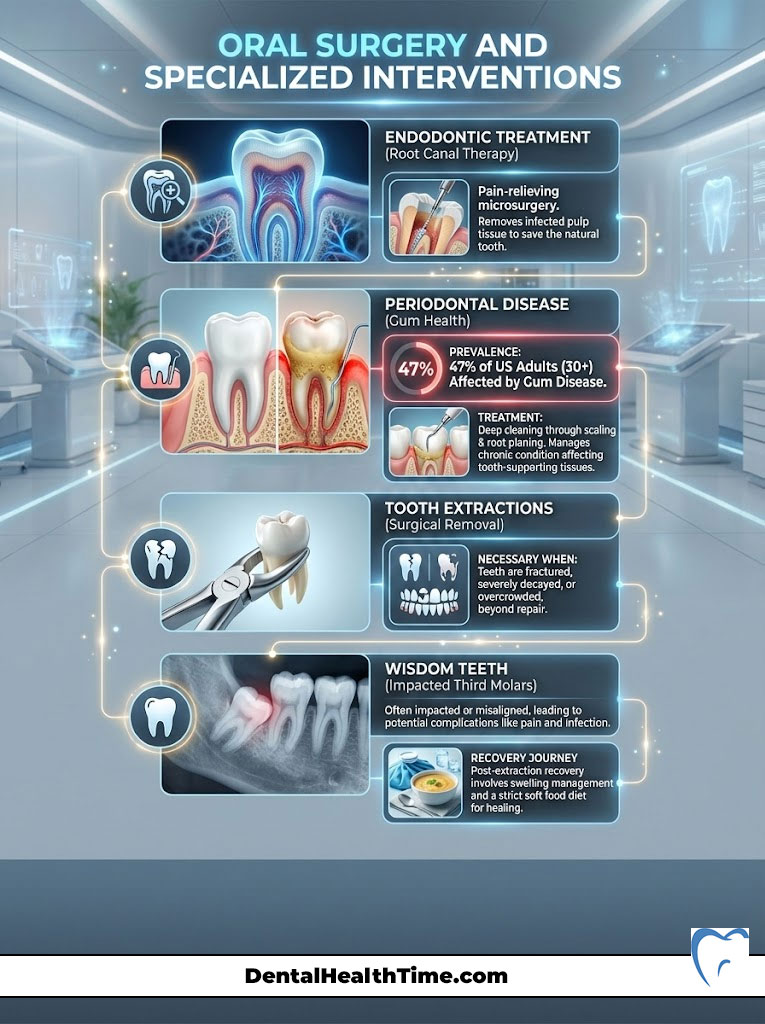
Few terms in dentistry trigger as much anxiety as “root canal.” However. a root canal (Endodontic treatment) is primarily a pain-relieving procedure. It is necessary when the soft pulp tissue inside the tooth becomes infected due to deep decay or trauma.
The procedure is microsurgical in nature:
- Access: The endodontist creates a small opening in the crown of the tooth.
- Cleaning: The infected pulp and nerves are removed from the root canals using tiny files.
- Disinfection: The hollow canals are sterilized to kill bacteria.
- Obturation: The canals are filled with a rubber-like material called gutta-percha.
- Restoration: Because the tooth no longer has a blood supply. it becomes brittle. A crown is almost always required to protect it from fracturing.
Periodontal Therapy and Gum Disease Management
Periodontal disease/gum disease is a chronic inflammatory condition affecting the tissues supporting the teeth. The CDC indicates that nearly 47% of US adults over 30 have periodontal disease. If left untreated. it destroys the jawbone and leads to tooth loss.
The first line of defense is deep cleaning scaling and root planing.
- Scaling: Removes tartar deposits from deep pockets below the gum line.
- Root Planing: Smooths the rough surfaces of the tooth root. This removes bacterial toxins and provides a clean surface for the gums to reattach.
- Maintenance: Patients with gum disease often require cleanings every three to four months to manage the bacterial load.
Tooth Extractions and Wisdom Teeth Removal
While the goal of dentistry is to save teeth. sometimes tooth extraction is the only viable option. This occurs when a tooth is fractured below the gumline. has severe decay that prevents restoration. or when severe crowding exists.
Wisdom teeth removal is a rite of passage for many young adults in the USA. These third molars often lack the space to erupt properly. They can become impacted. meaning they are trapped beneath the gum or bone. Impacted wisdom teeth can damage adjacent healthy molars. cause cysts. and lead to infection. Wisdom teeth removal recovery typically involves facial swelling and a diet of soft foods for a few days.
Orthodontics for Bite Correction and Alignment
Traditional Metal Braces
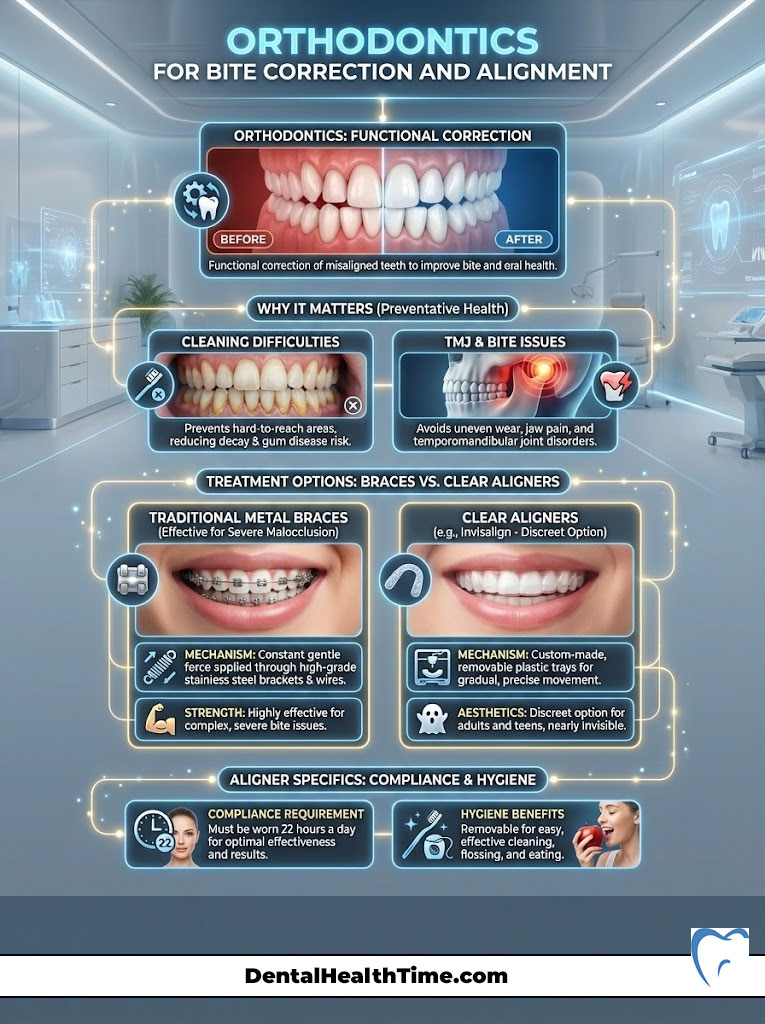
Orthodontics is not merely cosmetic; it is functional. Misaligned teeth are harder to clean and can cause jaw joint (TMJ) issues. Traditional braces use high-grade stainless steel brackets and wires. The wire applies a constant. gentle force to move teeth into the correct position. They remain the most effective tool for correcting severe malocclusion and complex bite issues.
Clear Aligner Technology and Invisalign
For adults and teens who want a more discreet option. clear aligners like Invisalign have become the standard. These are a series of custom-made. removable plastic trays. Each tray is designed to move the teeth slightly over two weeks before being replaced by the next tray in the series.
The American Dental Association (ADA) emphasizes that patient compliance is key. Clear aligners must be worn for at least 22 hours a day to be effective. They offer the advantage of being removable for eating and cleaning. improving hygiene compared to traditional braces.
Sedation Dentistry and Anxiety Management Techniques

Types of Sedation for Dental Anxiety
Fear of the dentist prevents millions of Americans from seeking necessary care. Sedation dentistry/Nitrous oxide options are designed to bridge this gap.
- Nitrous Oxide (Laughing Gas): This is a mild sedative inhaled through a nasal mask. It induces a feeling of relaxation and euphoria. It leaves the system quickly. allowing patients to drive themselves home after the appointment.
- Oral Conscious Sedation: This involves taking a prescription medication (usually a benzodiazepine) an hour before the visit. Patients remain awake but are deeply relaxed and often have little memory of the procedure.
- IV Sedation: Administered intravenously by a specialist or oral surgeon. This allows for precise control of sedation levels and is ideal for long or complex surgeries.
Local Anesthesia and Pain Control
Regardless of the sedation level. local anesthesia is used to block nerve signals in the specific area being treated. Agents like Lidocaine ensure that common dental procedures like fillings and crowns are virtually painless. Modern injection techniques and topical numbing gels have significantly reduced the discomfort associated with the “shot.”
Modern Innovations and Digital Dentistry
CAD/CAM Technology and Same-Day Restorations
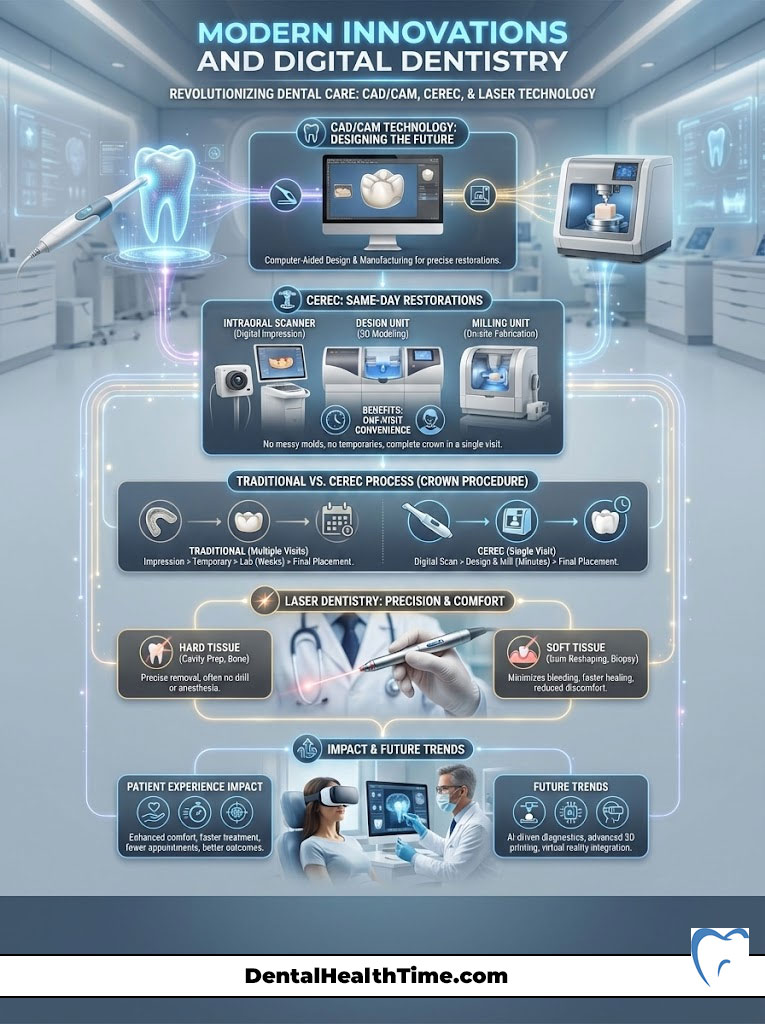
CAD/CAM technology/CEREC (Chairside Economical Restoration of Esthetic Ceramics) has transformed the speed of restorative dentistry. In the past. getting a crown required messy impression putty. a temporary cap. and a two-week wait for a lab.
With CEREC. the dentist scans your tooth with a specialized camera. The crown is designed on a computer screen (CAD) and then milled from a high-strength ceramic block right in the office (CAM). You can leave with a permanent. custom-glazed crown in a single appointment. reducing time away from work.
Laser Dentistry Benefits
Lasers are increasingly used for both hard and soft tissue procedures.
- Soft Tissue: Diode lasers can reshape gums (gingivectomy) with minimal bleeding and no need for sutures. They cauterize nerve endings as they cut. leading to less post-operative pain.
- Hard Tissue: Some lasers can be used to remove decay without the heat and vibration of a traditional drill. making the experience much more comfortable for the patient. Laser dentistry benefits also include sterilization of the area. reducing the risk of bacterial infection.
Navigating Dental Costs and Insurance in the USA

Categorizing Procedures for Insurance Coverage
Understanding the financial aspect of care is as important as the clinical side. Dental insurance (Basic/Major) plans in the USA typically use a “100-80-50” structure.
- Class I (Preventative): Exams. X-rays. and cleanings are usually covered at 100% because insurance companies know prevention saves money.
- Class II (Basic): Fillings. root canals. and simple extractions are often covered at 80%.
- Class III (Major): Crowns. bridges. dentures. and dental implants are typically covered at 50%.
Financing Options and Payment Plans
Because dental insurance often has a low annual maximum (typically $1.000 to $1.500). large treatment plans can exceed coverage quickly.
- Health Savings Accounts (HSA) and FSAs: These allow you to use pre-tax dollars for medical and dental expenses. effectively lowering the cost by your tax rate.
- CareCredit: This is a third-party financing credit card specifically for healthcare. It often offers interest-free financing for 6. 12. or 18 months. allowing you to spread the cost of treatments like dental implants over time.
Summary & Key Takeaways
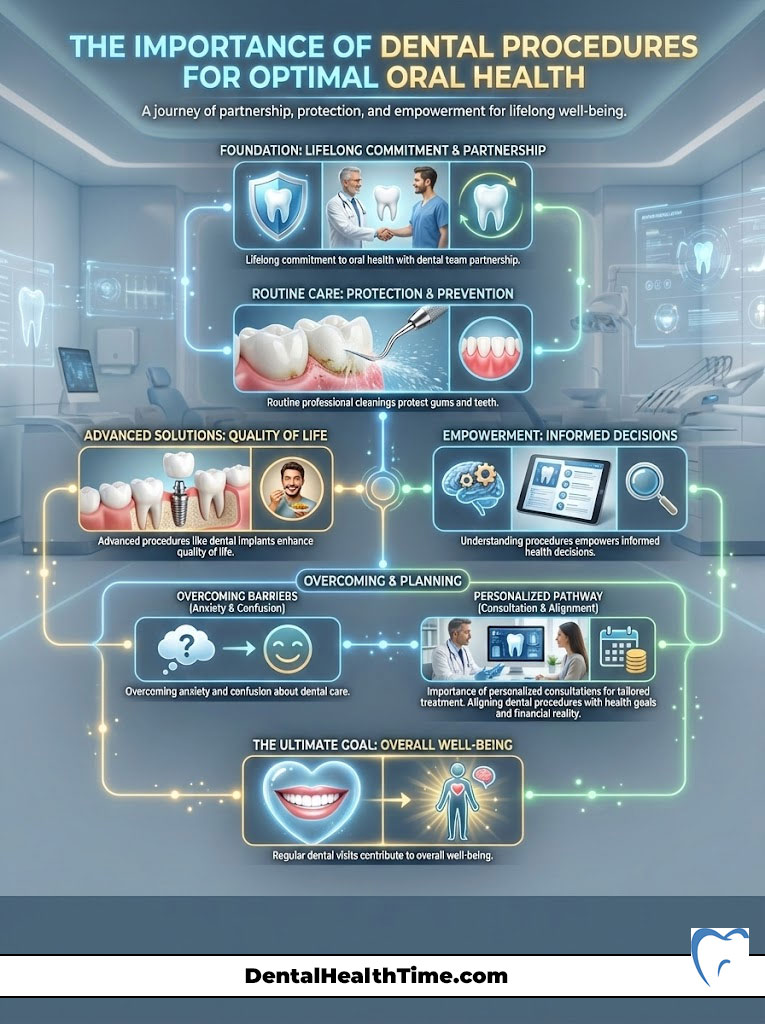
Your journey toward optimal oral health is a lifelong commitment that requires a partnership between you and your dental team. From the routine professional dental cleaning that protects your gums to the advanced engineering of dental implants. every procedure serves a vital role in maintaining your quality of life.
- Prevention is the Strategy: Investing in preventative care like sealants and exams is the most effective way to avoid pain and high costs later.
- Restoration Preserves Structure: Acting fast on cavities with fillings or crowns prevents the loss of the natural tooth.
- Technology Improves Comfort: Innovations like CAD/CAM technology/CEREC and sedation dentistry/Nitrous oxide have made modern dentistry faster. more precise. and more comfortable than ever before.
- Gum Health is Systemic Health: Treating periodontal disease/gum disease is not just about saving teeth; it is about protecting your heart and overall immune system.
By understanding the different types of dental procedures. you are empowered to make decisions that align with your health goals and financial reality. Do not let anxiety or confusion dictate your health. Schedule a consultation today to determine which specific procedures are right for your unique smile.
Frequently Asked Questions (FAQ)
What is the difference between a dental bridge and an implant?
A dental bridge uses the adjacent natural teeth as anchors to suspend a false tooth in the gap; this requires shaving down healthy enamel. An implant is a standalone titanium post surgically inserted into the jawbone to replace the root. Implants do not damage neighboring teeth and help preserve jawbone density.
How do I know if I need a deep cleaning (scaling and root planing)?
You likely need a deep cleaning if you have active signs of gum disease such as bleeding gums. persistent bad breath. or visible gum recession. Your dentist will measure the “pockets” between your teeth and gums using a probe; pockets deeper than 4mm usually indicate infection requiring deep cleaning scaling and root planing.
Are root canals painful?
This is a common misconception from decades ago. With modern local anesthesia and techniques. a root canal (Endodontic treatment) is typically no more painful than getting a regular filling. The procedure is designed to eliminate the severe pain caused by the infection. not to cause it.
What is considered a “major” dental procedure by insurance companies?
Insurance carriers typically classify complex. expensive. and lab-fabricated treatments as major. This generally includes crowns. bridges. dentures. and sometimes complex oral surgery. Dental insurance (Basic/Major) usually covers these procedures at 50%. whereas basic procedures like fillings are covered at 80%.
How long do dental implants last?
With diligent oral hygiene and regular checkups. dental implants are designed to be a permanent solution. While the titanium post in the jaw can last a lifetime. the porcelain crown on top may need replacement after 15 to 20 years due to normal wear and tear.
Can I get a dental cleaning while pregnant?
Yes. it is highly recommended and considered safe. Hormonal changes during pregnancy can increase the risk of “pregnancy gingivitis.” causing gums to swell and bleed. Routine preventative dentistry/care is essential for both maternal and fetal health to reduce bacterial load.
What are the signs that I need my wisdom teeth removed?
Common signs include pain or jaw stiffness near the back of the mouth. swelling. red gums. or crowding of the front teeth as the molars push forward. Your dentist will use X-rays to see if the teeth are impacted (stuck under the gum or bone).
Is teeth whitening safe for my enamel?
Yes. when performed under the supervision of a dental professional. Professional whitening gels are pH-balanced to ensure they do not erode enamel. Overusing harsh over-the-counter products or abrasive charcoals can cause sensitivity and damage.
How much does a porcelain veneer cost in the USA?
Porcelain veneers cost varies significantly by geographic location and the expertise of the dentist. Generally. the cost ranges from $900 to $2.500 per tooth. Since veneers are considered a cosmetic procedure. they are rarely covered by dental insurance.
What is the recovery time for a tooth extraction?
For a simple tooth extraction. the gum tissue usually heals in about 1 to 2 weeks. Wisdom teeth removal recovery may take slightly longer due to bone involvement. with full bone healing taking several months. though acute pain usually subsides within 3 to 5 days.
Do I really need dental X-rays every year?
Yes. X-rays allow dentists to see between teeth and under the gum line where the naked eye cannot reach. They are vital for diagnosing hidden decay. cysts. bone loss. and tumors early when they are easiest to treat.
What are the benefits of laser dentistry?
Laser dentistry benefits include reduced need for anesthesia. significantly less bleeding. and a lower risk of post-operative infection. Lasers cauterize tissue as they cut. leading to faster healing for soft tissue procedures like gum contouring.
Disclaimer
This article is for informational purposes only and does not constitute medical advice. diagnosis. or treatment. Always seek the advice of your dentist or other qualified health provider with any questions you may have regarding a medical condition or treatment. Costs and insurance coverage details mentioned are estimates based on USA averages and may vary.
References
- American Dental Association (ADA) – Clinical Practice Guidelines.
- Centers for Disease Control and Prevention (CDC) – Oral Health Surveillance Report.
- Journal of the American Dental Association (JADA) – Evidence-Based Dentistry.
- American Academy of Periodontology (AAP) – Gum Disease Statistics.
6 thoughts on “The Different Types of Dental Procedures Explained”