
You know the feeling. That dull, persistent throbbing in the back of your jaw that signals your wisdom teeth are finally making their presence known. But for many, the physical discomfort is quickly overshadowed by a sharper, more immediate pain: the fear of the bill. It is the single most common question patients ask their dentist, often before they even ask about the surgery itself.
Table of Contents
If you are asking, how much does it cost to remove wisdom teeth, the short answer is between $137 and $1,100 per tooth, depending heavily on impaction levels and insurance coverage. However, that range is deceptively simple. The final invoice you receive at the front desk is rarely just the sum of the tooth extractions. It is a complex equation of anesthesia fees, diagnostic imaging, and surgical difficulty—factors that can easily double your expected cost if you aren’t prepared.
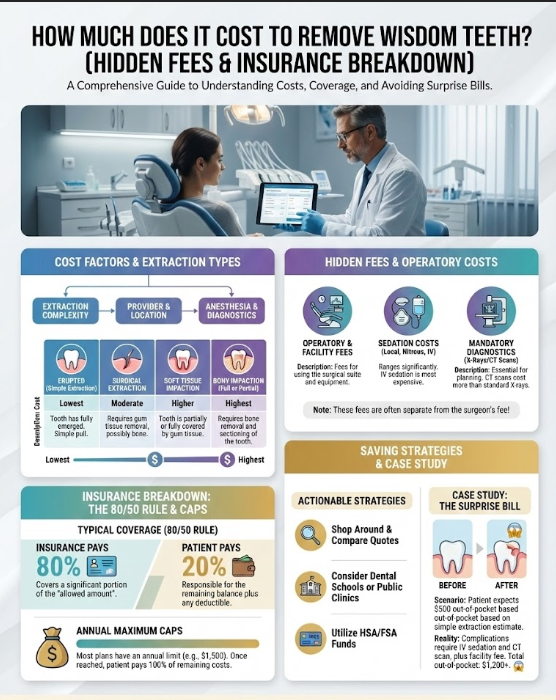
This guide goes beyond the sticker price. We will break down the total average cost of wisdom teeth removal, expose the “hidden” fees that oral surgeons often leave out of the initial quote, and explain how to navigate the insurance gap so you aren’t left with a surprise bill you can’t pay.
Quick Answer: Wisdom Teeth Removal Cost Breakdown
The average cost of wisdom teeth removal in the USA ranges from $137 to $335 per tooth for simple, erupted extractions. For impacted teeth, prices rise significantly: $325–$829 for soft tissue impactions and $413–$1,100+ for complete bony impactions.
When factoring in IV sedation ($500+), X-rays ($150+), and removing all four teeth, the total wisdom teeth removal cost without insurance typically falls between $2,500 and $4,000. Most dental insurance plans cover 50% to 80% of the procedure, but annual maximum caps (usually $1,500) often leave patients responsible for the remaining balance.
Wisdom Teeth Price Matrix: What to Expect
The price of extraction is not arbitrary. It is dictated by a strict set of medical codes known as CDT codes (Current Dental Terminology). Understanding these codes is your best defense against overcharging. Dentists do not bill for “wisdom teeth”; they bill for the surgical complexity required to remove them.
The difference between a $200 extraction and a $1,000 extraction comes down to one factor: Impaction.
The 4 Levels of Difficulty (and Cost)
1. Erupted / Simple Extraction (Code D7140)
This is the “best-case” scenario. The tooth has fully grown in (erupted) and is visible above the gum line. The dentist can remove it using forceps without making an incision.
- Cost Estimate: $137 – $335 per tooth.
- Who performs it: General Dentist or Oral Surgeon.
- Recovery: Minimal (2–3 days).
2. Surgical Extraction (Code D7120)
The tooth is visible but requires more than just pulling. The dentist may need to elevate a flap of gum tissue or remove a small amount of bone to get it out.
- Cost Estimate: $250 – $550 per tooth.
- Common Scenario: A tooth that has broken off at the gum line.
3. Soft Tissue Impaction (Code D7220)
Here, the tooth is stuck directly under the gum tissue but has cleared the bone. The surgeon must cut into the gum to access the tooth, requiring stitches.
- Cost Estimate: $325 – $829 per tooth.
- Healing: Slower; gums must heal over the socket.
4. Bony Impaction (Codes D7230 / D7240)
This is the most expensive and invasive category. The tooth is encased partially or fully in the jawbone.
- Partial Bony (D7230): Part of the crown is trapped in bone. Cost: $375 – $950.
- Complete Bony (D7240): The entire tooth is locked in bone. The surgeon must drill away bone and section the tooth (cut it into pieces) to remove it. Cost: $413 – $1,100+ per tooth.
- Note: Impacted wisdom teeth removal costs are highest here because of the time, skill, and risk involved.
The “Hidden Fees” Revealed: What Quotes Don’t Show
When you call a clinic and ask, “How much does it cost to remove wisdom teeth?“, they often quote you the extraction fee only. This is misleading. To get a realistic budget, you must add the “operatory costs” that appear on the final bill.
The High Cost of Sedation
If you have anxiety or are undergoing surgery for impacted teeth, local anesthesia (Novocaine) is rarely enough. You will likely want sedation, which is billed separately.
- Nitrous Oxide (Laughing Gas): A mild relaxant.
- Cost: $90 – $150 flat fee.
- Coverage: Rarely covered by insurance; usually out-of-pocket.
- IV Sedation / General Anesthesia: You are “asleep” (twilight sleep) and remember nothing.
- Cost: $250 – $800 per hour.
- Billing Trick: This is often billed in 15-minute increments after the first hour. If your surgery runs 15 minutes late, you could be charged an extra $200.
- Insurance Reality: Sedation dentistry cost is only covered if the extraction is deemed “medically necessary” (i.e., impacted teeth).
Mandatory Diagnostics
You cannot have surgery without a map.
- Panoramic X-Ray (Panorex – Code D0330): A standard bitewing X-ray doesn’t show the roots or the nerve canal. A Panorex wraps around your head to show the entire jaw.
- Cost: $100 – $250.
- 3D Cone Beam Scan (CBCT): If your roots are close to the mandibular nerve, the surgeon may demand a 3D scan to avoid permanent nerve damage.
- Cost: $300 – $600.
The Recovery Tax
The spending doesn’t stop when you leave the chair. The “Recovery Tax” includes items you need to heal safely.
- Prescriptions: Painkillers (Hydrocodone/Ibuprofen 800mg) and Antibiotics (Amoxicillin). Cost: $20 – $60 copay.
- Supplies: Extra gauze, irrigation syringes (to clean food out of sockets), and ice packs.
- Soft Food Diet: Stocking up on Greek yogurt, bone broth, smoothies, and protein shakes can add $50 – $100 to your weekly grocery bill.
Detailed Cost Comparison Table
Below is a transparent breakdown of the costs associated with different levels of surgical difficulty.
| Procedure Type | CDT Code | Est. Cost Per Tooth (No Insurance) | Surgical Complexity |
| Simple Extraction | D7140 | $137 – $335 | Low (Forceps only) |
| Surgical Extraction | D7120 | $250 – $550 | Medium (Requires gum incision) |
| Soft Tissue Impaction | D7220 | $325 – $829 | High (Gum incision + stitches) |
| Partial Bony Impaction | D7230 | $375 – $950 | Very High (Bone removal required) |
| Complete Bony Impaction | D7240 | $413 – $1,100+ | Max (Extensive bone removal + sectioning) |
Insurance Decoder: The “80/50 Rule” & Annual Caps
“Do I have coverage?” is the wrong question. The right question is, “How much of the bill will actually be paid before I hit my limit?”
How Coverage Actually Works
Most dental insurance plans in the US (Delta Dental, Cigna, Aetna) follow the 80/50 Rule for oral surgery:
- Simple Extractions are often classified as “Basic Services.” Coverage: 80%.
- Surgical/Impacted Extractions are classified as “Major Services.” Coverage: 50%.
This means for a complex surgery, you are automatically paying half the bill.
The $1,500 Trap (Annual Maximum)
This is where most patients get burned. Dental insurance is not like medical insurance; it has a low ceiling. Most plans have an Annual Maximum benefit of $1,000 to $1,500. Once the insurance company pays that amount, they stop paying completely for the rest of the year.
The Math:
If removing 4 impacted teeth + sedation costs $3,500:
- Insurance pays 50%: $1,750.
- BUT your cap is $1,500.
- Insurance pays: $1,500.
- You pay: $2,000 (The remaining balance).
Medical vs. Dental Insurance
In rare cases, medical insurance may cover wisdom tooth extraction cost with insurance. This usually only applies if:
- The teeth are caused by trauma (jaw fracture).
- There is a large cyst or tumor associated with the tooth.
- The surgery is performed in a hospital setting due to severe systemic health issues.
- Expert Tip: Always ask the oral surgeon to check both your medical and dental benefits.
Real-World Cost Scenarios
To help you budget, here are four common scenarios showing what you might actually pay.
| Scenario | Total Bill (Est.) | Insurance Pays (Est.) | Your Out-of-Pocket Cost |
| 1 Tooth (Simple) | $250 | $200 (80%) | $50 + Deductible |
| 4 Teeth (All Simple) | $1,000 | $800 (80%) | $200 + Deductible |
| 4 Teeth (Impacted) + IV Sedation | $3,500 | $1,500 (Capped Max) | $2,000 + Deductible |
| Emergency (1 Impacted) No Insurance | $900 | $0 | $900 |
Geography & Provider Factors
Where you live and who holds the forceps matters just as much as the tooth itself.
Why Your Zip Code Matters
Dental overhead varies by state. Wisdom teeth removal cost in coastal hubs like New York City, Los Angeles, or San Francisco is typically 20–30% higher than the national average. Conversely, procedures performed in the Midwest or rural South (Ohio, Texas, Alabama) tend to be on the lower end of the spectrum.
- Example: A D7240 extraction might cost $600 in Omaha but $1,100 in Manhattan.
General Dentist vs. Oral Surgeon
You can save money by having a General Dentist perform the extraction, as their fees are generally lower. However, general dentists typically only handle simple extractions or very mild impactions.
- Oral and Maxillofacial Surgeons are specialists with 4-6 extra years of hospital training. They charge a premium (specialist fee) but are necessary for bony impactions, nerves at risk, or complex sedation cases.
5 Actionable Strategies to Save Money
If the wisdom teeth removal cost without insurance feels out of reach, don’t panic. There are strategic ways to lower the bill without sacrificing safety.
1. Utilize Dental Schools
This is the single best way to save. Search for “CODA-accredited dental schools” near you. These universities have clinics where 3rd and 4th-year students perform surgery under the strict supervision of expert faculty.
- Savings: Typically 30% to 50% less than private practice.
- Trade-off: Appointments take longer, and there may be a waitlist.
2. Split the Surgery
If your wisdom teeth are not infected or causing emergency pain, ask your surgeon if you can split the procedure.
- Strategy: Remove the two teeth on the right side in December (using up this year’s insurance maximum). Remove the two on the left side in January (using next year’s refreshed maximum).
- Result: You get $3,000 of coverage instead of $1,500.
3. Shop for “Flat Rate” Packages
Some oral surgery clinics, specifically those that focus purely on extractions, offer “Self-Pay Packages.” These often bundle the consultation, X-ray, sedation, and removal of all four teeth for a flat cash price (e.g., $1,999). This avoids the line-item “surprise” additions.
4. Skip the IV Sedation (If Brave)
IV sedation is a luxury, not a medical necessity for everyone. If you have a high pain tolerance and only have simple or soft-tissue impactions, you can opt for Local Anesthesia only.
- Savings: Instantly knocks $600 – $1,000 off the bill.
- Warning: You will be awake and hear the noises (cracking/pressure), so this is not for the faint of heart.
5. Financing Options
If you must pay out of pocket, look into:
- CareCredit for wisdom teeth: A healthcare credit card that offers 0% interest for 6–12 months.
- HSA / FSA: Use your pre-tax Health Savings Account dollars. This effectively saves you 20–30% depending on your tax bracket.
Case Study: The “Surprise Bill” Analysis
Let’s look at a hypothetical patient, “Sarah,” to understand how costs snowball. Sarah has 4 wisdom teeth. She has dental insurance with a $1,500 max.
The Quote: “Your insurance covers 50%, so you’ll pay half.”
The Reality:
- Line 1: 4x Complete Bony Impactions (D7240) at $650 each = $2,600.
- Line 2: 1 Hour IV Sedation = $600.
- Line 3: Panoramic X-Ray = $150.
- Line 4: 15 Minutes Extra Sedation (Surgery ran long) = $150.
- Total Bill: $3,500.
The Insurance Calculation:
- Insurance covers 50% of $3,500 = $1,750.
- BUT Sarah’s cap is $1,500.
- Insurance pays $1,500.
- Sarah Pays: $2,000.
The Lesson: Sarah paid significantly more than “half” because she hit her cap. Always ask for a “Good Faith Estimate” that includes all codes and sedation time before booking.
Summary & Key Takeaways
The question “how much does it cost to remove wisdom teeth” has many answers, but the bottom line is preparation.
- Plan for $3,000+: Without insurance, budget around $3,000 for all four impacted teeth with sedation.
- Check Your Codes: Ensure you aren’t being billed for a “Bony Impaction” (D7240) if it’s just a “Simple Extraction” (D7140).
- Maximize Insurance: Use the end-of-year “split surgery” strategy if possible.
- Ask About Hidden Fees: specifically sedation increments and 3D scans.
Your recovery should be focused on ice cream and movies, not stressing over debt. By understanding the wisdom tooth extraction cost with insurance breakdown, you can walk into the oral surgeon’s office with confidence and control.
Frequently Asked Questions (FAQ)
How much does it cost to remove all 4 wisdom teeth without insurance?
On average, the total cost to remove all four wisdom teeth without insurance is between $2,500 and $4,000. This assumes the teeth are impacted and includes the cost of IV sedation and X-rays. If the teeth are fully erupted and simple to pull, the cost could be lower, around $1,000 to $1,500.
Does Medicaid cover wisdom teeth removal for adults?
It depends on your state. In most states, Medicaid only covers dental extractions for adults if it is deemed a medical emergency (e.g., severe infection or pain). Routine or preventative removal is rarely covered. You should check your specific state’s Medicaid dental benefits list.
Why is impacted wisdom tooth removal so expensive?
Impacted wisdom teeth removal costs more because it is a surgical procedure, not just a simple extraction. The surgeon must cut through gum tissue, drill away jawbone, and often section the tooth into pieces to remove it safely. This requires higher skill, more time, and carries higher risks than pulling a visible tooth.
Can I decline the panoramic X-ray to save money?
Generally, no. An oral surgeon cannot safely operate without a current Panoramic X-ray (Panorex). They need to see the exact position of the tooth roots relative to the mandibular nerve and sinus cavity. However, if you had a Panorex taken at another dentist within the last 6 months, you can have it forwarded to save the $100–$200 fee.
How much does IV sedation cost for oral surgery?
IV sedation typically costs between $500 and $800 for the first hour, and is often billed in 15-minute increments thereafter. Nitrous oxide (laughing gas) is a cheaper alternative, usually costing a flat fee of $90–$150.
Is it cheaper to have wisdom teeth pulled at a dental school?
Yes, dental schools are significantly cheaper. You can save 30% to 50% compared to private oral surgeons. The procedures are performed by supervised dental students or residents. The trade-off is often longer appointment times and limited availability.
Does medical insurance ever cover wisdom teeth removal?
Medical insurance rarely covers standard wisdom teeth removal. However, it may provide coverage if the impaction is complicated by a cyst, tumor, or if the extraction is required prior to major jaw surgery or radiation therapy. Always ask your provider to check medical benefits just in case.
What is the difference between simple and surgical extraction costs?
A simple extraction (Code D7140) costs roughly $137–$335 and involves pulling a visible tooth. A surgical extraction (Code D7120) costs $250–$550 and involves lifting the gum flap to access the tooth. The price difference reflects the additional time and instruments needed.
Do I have to pay for the consultation separately?
Yes, most oral surgeons charge a separate consultation fee ranging from $100 to $200. This covers the exam and diagnosis. Some clinics may waive this fee if you book the surgery and pay a deposit on the same day.
Can I use CareCredit for anesthesia costs?
Yes, CareCredit for wisdom teeth can be used to pay for the entire final bill, including anesthesia, medications, X-rays, and the surgery itself. It acts as a credit card for healthcare expenses.
How much does emergency wisdom tooth removal cost?
Emergency removal often costs the same as standard removal per tooth ($250–$1,000), but you may be charged an additional “Palliative Treatment” fee (Code D9110) or an after-hours office visit fee, which can add $100–$300 to the bill.
Are there hidden fees I should ask my surgeon about?
Yes. Ask specifically about “facility fees,” “biopsy fees” (if they remove tissue), and if the follow-up visit is included in the price. Also, ask if they bill sedation by the hour or by the minute, so you aren’t surprised if the surgery runs long.
Disclaimer:
The costs and codes listed in this article are estimates based on 2024-2026 national averages in the USA. Actual prices vary significantly by location, provider, and individual insurance plan. This guide does not constitute medical or financial advice. Always request a detailed “Good Faith Estimate” from your provider before undergoing surgery.
References:
- American Dental Association (ADA) – CDT Code Documentation.
- Consumer Health Ratings – National Dental Fee Averages.
- Delta Dental & Cigna Insurance – Benefits & Coverage Policies.