
It is 2 AM on a Wednesday. You had your wisdom teeth removed three days ago, and until tonight, everything seemed to be progressing according to the pamphlet the oral surgeon gave you. But now you are awake, pacing the hallway, clutching a bag of frozen peas to your jaw. The throbbing pain is relentless, refusing to fade even after you took the painkillers your surgeon prescribed. You find yourself staring into the bathroom mirror with a flashlight, trying to see past the swelling, asking yourself the one question every dental patient dreads: Is this normal, or is it that thing?
Table of Contents
Knowing how do I know if I have dry socket is not just about identifying the presence of pain; it is about recognizing specific, unmistakable patterns of recovery that deviate from the norm. Most surgical wounds get better every single day. Dry socket is unique because it gets worse just when you think you are out of the woods.
Alveolar osteitis, commonly known as dry socket, is a specific, debilitating pain condition that occurs when the protective blood clot at the extraction site dissolves, dislodges, or fails to form entirely. This exposes the underlying alveolar bone and highly sensitive nerve endings to air, food, saliva, and fluids. While you cannot professionally diagnose yourself with the precision of an oral surgeon, you can use the Day 3 Rule, specific visual cues, and sensitivity tests to determine if you need to make that emergency call.
This comprehensive guide provides a deep-dive breakdown of dry socket symptoms, analyzing exactly what does dry socket feel like, how to distinguish it from normal healing or infection, and why the timing of your pain is the ultimate diagnostic tool.
The Core Warning Sign: The “Day 3” Pain Timeline
To understand your symptoms, you first need to understand the clock. Your body heals on a biological schedule. Dry socket symptoms rarely appear on the first day of surgery. They follow a specific, delayed timeline that acts as the single most reliable warning sign for patients.
The Normal Healing Curve vs. The Dry Socket “U-Turn”
Surgical recovery is usually linear. It starts at its worst and incrementally improves.
- Day 1 (The Trauma Phase): The anesthesia wears off. You feel significant discomfort, but it is expected. The pain is moderate to severe but is generally manageable with the prescribed medication and ice.
- Day 2 (The Swelling Peak): Swelling and soreness reach their maximum point. You may look like a chipmunk, and your jaw may be stiff. However, the sharp, acute pain usually begins to plateau.
- Day 3 and Beyond (The Improvement Phase): You should feel roughly 10% to 20% better each day. The need for strong prescription medication should decrease, and you might switch to over-the-counter options.
Dry socket symptoms break this fundamental rule of healing. They create a distinct “U-Turn” in your recovery trajectory. You might feel surprisingly okay on Days 1 and 2. You might even text your friends that the surgery was “easier than expected.” Then, suddenly, on Day 3, 4, or 5, the pain spikes dramatically. This delayed onset is the hallmark of alveolar osteitis. If your pain was a 3/10 yesterday and is an 8/10 today, that is a massive red flag.
Biological Reasons Why Dry Socket Symptoms Spike on Days 3 to 5
This specific timing happens because of biology, not coincidence. The condition is caused by a process called fibrinolysis. Fibrinolysis is a chemical reaction where the body releases enzymes (kinases) to break down the fibrin mesh holding the blood clot together.
In a healthy socket, this happens very slowly, only after new tissue has grown underneath. In a dry socket, this process accelerates aggressively, often triggered by bacteria, saliva, or estrogen. Research published in the Journal of Oral and Maxillofacial Surgery indicates that 95% of dry socket cases develop within the first week, with the peak incidence occurring specifically between 72 and 96 hours post-extraction.
This is the window when the blood clot is most vulnerable to dissolving. Once the clot is gone, the bone is exposed. It takes a few hours for the nerves to fully register this exposure, leading to the sudden, jarring wake-up call of pain on the third or fourth day.
Differentiating Day 1 Surgical Trauma from Delayed Alveolar Osteitis
It is crucial to distinguish between surgical trauma and dry socket. If you had a difficult extraction—perhaps the dentist had to drill bone or section the tooth—you will have significant pain on Day 1. This is “surgical pain.” It is caused by the trauma to the tissues.
Dry socket pain is “nerve exposure pain.” Surgical pain feels like a bruise or a deep cut; it is sore and tender. Dry socket pain feels active and electric. If your pain is high on Day 1 and stays high on Day 2 and Day 3 without getting worse, that might just be a slow recovery from a difficult surgery. But if the pain drops and then rebounds to an excruciating level, that rebound is the diagnostic key.
Analyzing the Specific Quality of Dry Socket Pain Symptoms
Identifying the condition requires analyzing the quality and texture of the pain. It is not just a standard toothache. What does dry socket feel like is a question best answered by describing the intensity, the rhythm, and the path the pain travels through your head and neck.
Deep Throbbing Pain vs. Superficial Soreness
Normal surgical pain often feels superficial—like your gums are raw. Dry socket symptoms manifest deeper.
- Deep Bone Pain: Patients consistently describe it as a boring, drilling ache that feels like it is coming from inside the jawbone itself. It feels “hollow” yet heavy.
- The Pulse: The pain often has a rhythmic quality. It is a throbbing pain that beats in time with your heart. This happens because the exposed bone is inflamed, and every heartbeat pumps blood into the sensitive, confined space of the socket. The pressure from the blood pulse against the raw nerve endings causes that rhythmic pounding sensation.
- Relentless Nature: Unlike soreness which might fade if you watch a movie or distract yourself, this pain is often all-consuming. It demands your attention constantly and makes it difficult to focus on work, conversation, or sleep.
Radiating Pain to the Ear, Temple, and Neck Via the Trigeminal Nerve
One of the most distinct signs of dry socket is that the pain does not stay in the extraction hole. It travels. This is often the symptom that confuses patients the most, leading them to believe they have an ear infection rather than a dental complication.
- The Trigeminal Nerve Connection: The nerves in your jaw are branches of a massive cranial nerve called the Trigeminal Nerve. This nerve system covers the jaw, the face, the ear, and the temple. When the alveolar bone is exposed, this main nerve gets overstimulated.
- Referred Pain Patterns: Because the signal is so intense and overwhelming, your brain struggles to pinpoint the exact source. This phenomenon is called “referred pain.” Instead of just feeling pain in the gum, you will feel radiating pain shooting up to your ear, your temple, behind your eye, or down into the muscles of your neck.
- Actionable Insight: If your jaw is sore, that is normal. If your ear is ringing, aching, or feels like it is being stabbed with an ice pick on the same side as the extraction, and your ear was fine before surgery, this is a classic, almost definitive symptom of alveolar osteitis.
Why Over-the-Counter Painkillers Like Tylenol Fail to Stop Dry Socket Pain
Another way to answer how do I know if I have dry socket is to check the effectiveness of your medicine cabinet.
- The Mechanism of OTC Drugs: Over-the-counter medications like Ibuprofen (Advil, Motrin) and Acetaminophen (Tylenol) work primarily by reducing inflammation and blocking prostaglandin production. Normal surgical pain is largely inflammatory, so these drugs tend to work well.
- Nerve Exposure Resistance: Dry socket is not just inflammation; it is direct, raw nerve exposure. The nerve endings are naked to the air. Standard anti-inflammatory drugs are often not strong enough to block this level of raw nerve signal. It is like trying to use a small bandage to stop a dam from bursting.
- The Medication Red Flag: If you take a full dose of your painkillers and feel zero relief after 45 minutes, or if the relief wears off in an hour instead of four, this medication not working scenario is a strong indicator of a complication. If you find yourself counting the minutes until you can take your next pill because the pain is breaking through the barrier, you likely have a dry socket.
Visual Diagnostics: What Does a Dry Socket Look Like in the Mirror?
If the pain analysis leaves you unsure, your next step is the mirror check. You will need a flashlight (or your phone’s torch function) and a bit of courage to look into the back of your mouth. Be gentle and do not pull your cheek too hard, as you do not want to tear any stitches.
Distinguishing the “Black Hole” Appearance from a Healthy Blood Clot
A healthy socket is messy. It is supposed to be. It is a wound in the process of healing.
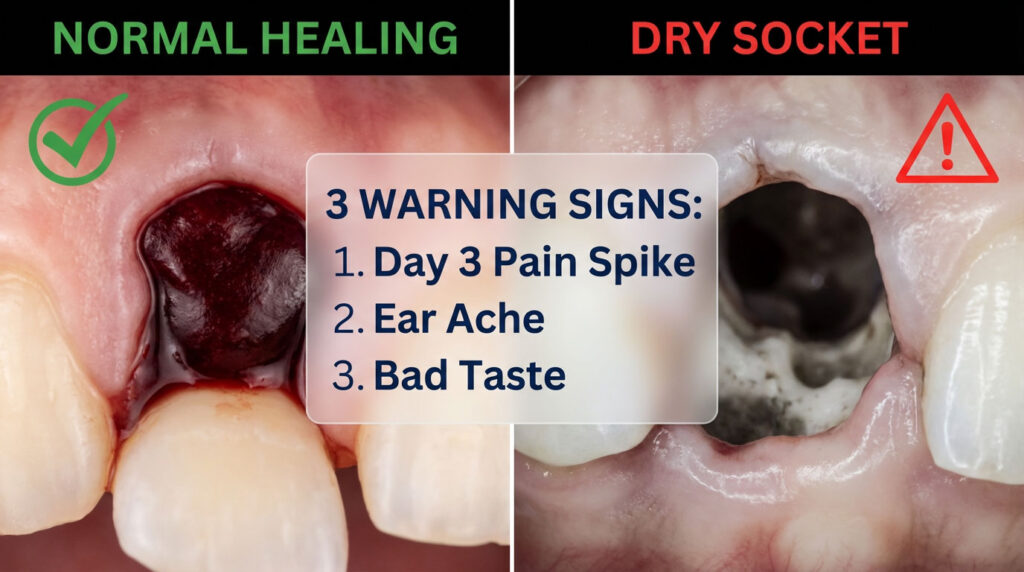
- Normal Appearance: In a healing socket, you should see a dark red, deep purple, or even blackish scab. This is the blood clot. As days pass, this may turn into creamy white or yellowish material. This is granulation tissue, which is essentially new skin forming. It looks soft, moist, and web-like.
- Dry Socket Appearance: When you shine a light into a dry socket, it looks like a dark, deep void. It appears “empty” because the plug that should be there is missing. This is often referred to as the “black hole” appearance. You are looking past the gum line and down into the socket itself.
Identifying Exposed Alveolar Bone vs. Healthy Granulation Tissue
Sometimes the hole is not just dark; you can actually see the anatomy. Distinguishing bone from tissue is critical.
- Color Guide: Bone inside the mouth does not always look bright white like a skeleton in a cartoon. Exposed bone can look greyish, yellowish, or off-white. It often has a matte, dry finish.
- Texture Contrast: Healthy granulation tissue is glistening, wet, and fleshy. Exposed bone looks hard, dry, and rock-like. It stands out against the soft, wet, pink gum tissue surrounding it.
- The “White Stuff” Confusion: Patients often panic when they see white material. Ask yourself: does it look soft and fluffy (like wet bread or a spiderweb)? That is good granulation tissue. Does it look hard, polished, or like a pebble? That is likely exposed bone, a key visual among signs of dry socket.
How to Safely Inspect Your Extraction Site Without Causing Damage
While looking is helpful, poking is dangerous.
- No Probing: Never stick a toothpick, cotton swab, or your finger into the socket to “check” if the bone is exposed. You introduce bacteria and risk dislodging a clot that might still be partially attached.
- Flashlight Angle: Hold the flashlight outside your mouth, angled in. Use the handle of a clean spoon to gently retract your cheek if necessary.
- Limit Frequency: Do not check every ten minutes. Constantly stretching your mouth open can irritate the surgical site and cause muscle spasms (trismus), adding to your pain.
Sensory Symptoms: Bad Taste in Mouth and Halitosis
Pain is the primary symptom, but your other senses can also provide clues. The condition often has a distinct smell and taste profile.
The Distinct Foul Odor of Fermenting Food Debris and Tissue
When the blood clot is lost, the socket becomes a food trap. There is no tissue to keep debris out.
- Bacterial Fermentation: Food particles, saliva, and bacteria collect in the open hole. Because the bone is exposed and there is no blood supply to flush the area, this mixture begins to ferment and rot.
- The Smell: This process produces a very strong, unpleasant odor. Patients often report bad breath after wisdom teeth removal that cannot be brushed away. It is a distinct “rotting” smell that lingers regardless of how much mouthwash you use.
Differentiating Between Infection Taste and Dry Socket Rotting Taste
- Infection Taste: An active infection usually produces pus. Pus has a salty, metallic, or sour taste.
- Dry Socket Taste: Alveolar osteitis tastes like old pennies, rotting meat, or decay. It is a “stale” taste.
- The Persistence: This bad taste in mouth is usually constant. It might fade slightly after rinsing but returns within minutes as the bacteria continue to break down debris in the socket.
Why You Might Have a Bad Taste in Mouth Without Pain
We often see searches for “I have a hole but no pain” or “bad taste in mouth after tooth extraction but no pain.” These scenarios cause unnecessary panic but usually do not indicate dry socket.
- The Cause: This is usually fermenting food debris trapped in a normally healing divot. Rice, bread, or meat can get trapped in the healing hole. Because you cannot brush inside the hole, the food breaks down, causing halitosis (bad breath).
- The Verdict: If you have a terrible taste but your jaw feels fine and you have no radiating pain, you do not have dry socket. This is a hygiene issue, not a medical emergency. Use a syringe (if provided by your dentist) or gentle salt water rinses to flush the debris out.
Performing Safe Self-Check Sensitivity Tests at Home
You cannot perform surgery on yourself, but you can perform safe sensitivity tests to gauge the status of your nerve endings. These “provocation tests” can help confirm if the bone is truly exposed or if you are just dealing with normal soreness.
The Inhale Test: Reacting to Air Exposure on the Nerve
Nerves hate air. One of the main reasons dentists cover the site is to insulate the nerve endings from the air you breathe.
- The Test: Open your mouth slightly and breathe in sharply and quickly through your mouth (like a gasp), letting the air stream hit the extraction site directly.
- The Result: If you feel a mild coolness or slight ache, that is normal sensitivity. If you feel a blinding “zing” of shock-like pain that makes you wince, grab your face, or brings tears to your eyes, the nerve is likely exposed. This extreme sensitivity to air is a primary answer to what does dry socket feel like.
The Cold Water Sensitivity Test for Exposed Nerve Endings
Similar to air, thermal changes trigger exposed nerves instantly.
- The Test: Take a small sip of cold water. Swish it gently near the extraction site.
- The Result: Normal healing sockets might be slightly sensitive to cold. A dry socket will react with agonizing, electric-shock type pain. This hypersensitivity confirms that the insulation (the blood clot and granulation tissue) is missing.
- Note: If the cold water relieves the pain, it might be inflammation. If it spikes the pain, it is nerve exposure.
Dangers of Probing the Socket with Objects
A critical warning: Do not poke the socket with a toothpick, cotton swab, tongue, or any other object to “test” for bone.
- Risk of Infection: You introduce new bacteria into a sterile bone environment.
- Clot Disruption: You might dislodge a clot that is only partially loose, turning a minor issue into a full-blown dry socket.
- Bone Damage: Scraping the delicate alveolar bone can cause further inflammation and delay healing.
Differential Diagnosis: Dry Socket vs. Infection vs. Normal Healing
Many patients confuse dry socket symptoms with infection symptoms. They assume that because it hurts and smells bad, it must be infected. However, the two conditions are fundamentally different and require different treatments. Antibiotics will not fix a dry socket, and a medicated dressing won’t cure a deep infection.
Recognizing Signs of Infection Like Fever and Swelling vs. Localized Pain
Infection after tooth extraction (post-operative infection) is actually less common than dry socket, but it is more dangerous if ignored.
- Fever: Infections are systemic. They usually come with a fever over 100.4°F (38°C) and chills. Dry socket is a localized inflammatory condition; it rarely causes a fever.
- Swelling: In a dry socket, the swelling usually goes down normally (following the Day 2 peak) even though the pain goes up. In an infection, the swelling will increase after Day 3, often spreading to the cheek, under the eye, or down the neck.
- Discharge: Infections produce thick, yellow or green pus that oozes from the gums. Dry socket is “dry”—there is no pus, just bare bone and saliva.
- Heat: If the skin on your cheek feels hot to the touch, that is a sign of infection. Dry socket pain is internal and does not typically heat up the external skin.
Is It Lockjaw (Trismus) or Dry Socket?
Another common condition is trismus, or lockjaw, where you cannot open your mouth fully.
- The Difference: Trismus is muscle stiffness. It hurts to stretch the jaw, but it doesn’t throb when you are sitting still. Dry socket hurts constantly, whether you are moving your jaw or not. You can have both at the same time, but they are separate issues.
The “Painless Dry Socket” Myth: Understanding Delayed Healing
We often receive questions asking, “Can you have dry socket without pain?”
- The Medical Definition: Technically, no. The medical definition of alveolar osteitis is painful inflammation of the bone.
- The Empty but Painless Socket: You may look in the mirror and see what looks like an empty hole. You may have lost the top part of the clot. However, if granulation tissue has covered the bone at the bottom just enough to insulate the nerves, you will feel no pain.
- The Verdict: If you have no pain, you do not have a condition that needs treatment. It is simply a “delayed healing socket.” It will heal on its own. Do not worry about it, and do not let the visual appearance panic you if the sensation is fine.
Comparison Table: Visual & Sensory Checklist
| Feature | Normal Healing Socket | Dry Socket (Alveolar Osteitis) | Post-Op Infection |
| Visual Look | Dark red clot OR White webby tissue. | Empty hole OR Visible grey/white exposed bone. | Swollen gum, yellow/green pus discharge. |
| Pain Pattern | Improves daily; responds to meds. | Worsens on Day 3-5; resists meds. | Worsens gradually; constant throb. |
| Ear Pain | Rare/None. | Common (Radiating pain to ear/neck). | Rare, unless infection spreads significantly. |
| Smell/Taste | Mild metallic (blood) taste. | Foul, rotting odor (halitosis). | Salty, sour taste of pus. |
| Fever | None. | Rare. | Common (>100.4°F). |
| Touch Sensitivity | Tender but manageable. | Exquisite pain if air/water hits it. | Painful to touch, skin feels hot. |
Risk Factor Analysis: Did I Cause My Dry Socket?
When the diagnosis becomes clear, the first reaction is often guilt. “Did I cause this?” While some factors are under your control, others are purely biological. Understanding the cause can help you prevent it in future extractions.
Impact of Smoking and Vaping on Blood Clot Stability
Smokers and vapers are at the highest risk.
- Suction: The physical act of inhaling creates a vacuum that can pull the clot out.
- Chemical Toxicity: Nicotine and carbon monoxide reduce oxygen flow to the tissues. Without oxygen, the fibroblasts cannot repair the wound, and the clot fails to anchor. If you smoked within the first 72 hours, this is a likely contributor.
Oral Contraceptives and Estrogen Cycles Affecting Fibrinolysis
This is a factor many patients are unaware of.
- The Estrogen Link: High levels of estrogen (either naturally during the cycle or artificially from birth control pills) activate the fibrinolytic system. This encourages the body to dissolve blood clots.
- The Statistics: Women on oral contraceptives have a 20% to 30% higher risk of developing dry socket. This is not something you “caused” by behavior, but a biological predisposition.
Traumatic Extraction of Mandibular Wisdom Teeth
Anatomy plays a huge role.
- Lower vs. Upper: Dry sockets occur much more frequently in the lower jaw (mandible) than the upper jaw (maxilla). The lower jaw bone is denser and has less blood supply.
- Surgical Difficulty: If your tooth was impacted, required bone removal, or took a long time to extract, the trauma to the bone releases more inflammatory markers, which can trigger clot dissolution. If you had a “difficult” surgery, your risk is naturally higher regardless of your aftercare.
Treatment Options and Relief for Alveolar Osteitis Pain
If you have gone through this guide and ticked the boxes—Day 3 spike, radiating pain to the ear, empty-looking socket—you likely have it. The next question is: what now?
Professional Medicated Dressings with Eugenol and Anesthetics
You cannot cure a dry socket at home; you can only manage the symptoms until you see a doctor. The professional treatment is almost miraculous in its speed.
- The Procedure: Your oral surgeon will gently flush out the debris from the socket with saline. They will then pack the hole with a medicated dressing or paste (often called Alvogyl).
- Ingredients: This paste typically contains eugenol (clove oil), a topical anesthetic (like lidocaine or benzocaine), and an antiseptic (iodoform).
- Instant Relief: Because the paste covers the exposed bone, the relief is often felt within 2 to 5 minutes. The throbbing pain vanishes. This dressing acts as an artificial clot. It is not a cure—it is a pain blocker. It may need to be changed every 24 to 48 hours until your body grows its own granulation tissue.
Using Clove Oil as a Temporary Home Remedy for Nerve Pain
If it is Friday night and you cannot see a surgeon until Monday, you need a survival plan.
- Clove Oil: You can buy clove oil at a pharmacy. It contains eugenol, the same active ingredient dentists use.
- Application: Apply a tiny amount (it is very strong!) to a piece of clean gauze and gently place it near the site. Do not pour oil directly into the socket, as it can burn the gum tissue.
- The Effect: The eugenol acts as a natural obtundent (numbing agent) for the bone. It can provide relief for 1-2 hours at a time.
Combining NSAIDs for Maximum Pain Management
If professional help isn’t immediately available, managing the pain chemically is the priority.
- The Strategy: Studies suggest that taking Ibuprofen (Advil) and Acetaminophen (Tylenol) together is more effective for dental nerve pain than opioids alone.
- Mechanism: Ibuprofen tackles the inflammation, while Tylenol blocks pain signals in the brain. Note: Always consult your doctor before mixing medications to ensure it is safe for your specific health profile.
Recovery Timeline: How Long Does Dry Socket Last?
The most common question after “Do I have it?” is “When will it end?”
The Duration of Pain Without Professional Treatment
If left untreated, dry socket pain is self-limiting. The body will eventually heal the wound by growing tissue from the bottom up to cover the bone. However, without the medicated dressing, this process usually takes 7 to 10 days of severe pain. You essentially have to wait for the bone to cover itself.
How Quickly Treatment Resolves Symptoms
With professional treatment, the pain relief is immediate. However, the dressing does not speed up healing; it just makes the healing process painless. You may need to return to the dentist 2 or 3 times to have the dressing changed.
Long-Term Healing of the Socket: Granulation from the Bottom Up
A dry socket heals by “secondary intention.” This means the hole fills in from the bottom up, rather than the edges closing over the top.
- Week 1-2: Granulation tissue covers the bone. Pain subsides.
- Month 1: The socket is still a hole, but it is lined with soft tissue. Food will still get stuck, but it won’t hurt.
- Month 3-4: The bone fills in, and the hole eventually disappears completely.
Summary & Key Takeaways
Knowing how do I know if I have dry socket comes down to recognizing the pattern. It is a specific, unmistakable deviation from normal healing.
- Watch the Clock: The “Day 3 Spike” is your biggest clue. If pain worsens after getting better, pay attention.
- Check the Path: If the pain is radiating pain that shoots to your ear, temple, or neck, it is likely nerve exposure.
- Look for the Void: An empty-looking socket with greyish exposed bone confirms the diagnosis.
- Smell the Signs: A foul odor or bad taste in mouth accompanies the pain.
- Final Rule: If you can control the pain with standard medication, wait it out. If the medication fails and the pain keeps you awake, call your surgeon.
Remember, alveolar osteitis is a temporary condition. It will heal on its own in 10 to 14 days. The goal of treatment is simply to stop you from suffering while your body does the hard work of rebuilding.
Frequently Asked Questions (FAQ)
Does dry socket pain come and go or is it constant?
It is usually constant. The throbbing pain is relentless and deep. While it may fluctuate slightly in intensity (often getting worse at night), it rarely disappears completely for hours and then returns. It is often described as a constant background ache that spikes into sharp pain when you move, eat, or breathe cold air.
Why do I have a bad taste in my mouth days after extraction?
You must differentiate between food debris and dry socket. If the bad taste in mouth is accompanied by severe pain, it is dry socket caused by rotting tissue and food fermentation. If it is painless, it is likely just trapped food. Gentle rinsing with a syringe usually resolves the painless version.
Does dry socket cause ear or neck pain?
Yes. This is one of the most common misdiagnoses. Patients go to the doctor for an ear infection, not realizing it is their tooth. The exposed bone overstimulates the Trigeminal Nerve, referring pain up to the ear, temple, or down the neck muscles.
Can you have dry socket without pain?
No. By medical definition, if there is no pain, it is not a “dry socket” condition requiring treatment. You may have an empty-looking socket where the clot washed away, but if the bone is covered by even a thin layer of granulation tissue, you will be pain-free. This counts as normal healing and requires no intervention.
Is throbbing pain normal 3 days after extraction?
Mild throbbing can be normal as blood flow increases to heal the area. However, throbbing pain that is worsening on Day 3, rather than improving, is the red flag. If the throbbing is severe enough to distract you from daily tasks or prevents sleep, it is likely dry socket.
How long does dry socket pain last without treatment?
If left untreated, the severe pain usually lasts for 7 to 10 days. The body effectively has to heal the wound the “hard way” (secondary intention) by growing tissue from the bottom up to cover the bone. Professional treatment with a medicated dressing stops the pain immediately, though the biological healing time remains similar.
Does salt water help dry socket?
Salt water helps prevent infection, but it does not stop dry socket pain. Because the pain is caused by exposed bone, rinsing with salt water is like washing a scraped knee—it keeps it clean, but it doesn’t stop the sting. In fact, cold water can hurt a dry socket. Always use warm water.
What are the signs of infection vs dry socket?
The main difference is fever and swelling. Infection typically causes a fever (>100.4°F), swelling that spreads to the cheek or eye, and thick pus. Dry socket symptoms are primarily pain and bad smell, usually without fever or increasing facial swelling.
Disclaimer: The information provided in this article is for educational purposes only and does not constitute medical advice. If you are experiencing severe pain, uncontrolled bleeding, fever, or swelling that impairs breathing after a tooth extraction, please consult your dentist or oral surgeon immediately for professional diagnosis and treatment.
References:
- Journal of Oral and Maxillofacial Surgery. “Incidence and Risk Factors for Alveolar Osteitis.”
- American Dental Association (ADA). “Dry Socket Overview and Management.”
- Mayo Clinic. “Dry socket – Symptoms and causes.”
- National Institutes of Health (NIH). “Management of Dry Socket: A Clinical Review.”
- Cochrane Library. “Local interventions for the prevention of alveolar osteitis (dry socket).”