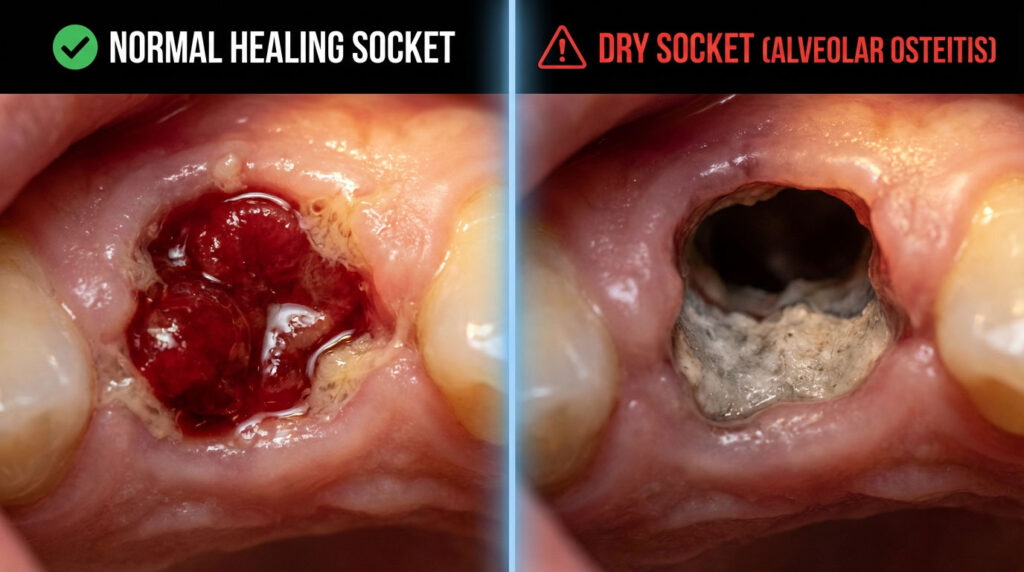

You just had a tooth pulled and now you are staring into the bathroom mirror with a flashlight, trying to see what is happening inside your mouth. You are likely asking yourself: Is that dark hole normal? Is that white stuff infection? The fear of alveolar osteitis (dry socket) is the most common anxiety patients face immediately after oral surgery. It is difficult to know what is “safe” when everything inside your mouth looks red, swollen, and tender.
Table of Contents
This guide provides a definitive answer to what does a dry socket look like compared to a healthy recovery. We will break down the specific visual cues of dry socket vs normal healing, analyze the often-confusing white stuff in wisdom tooth hole, and outline the specific dry socket symptoms you need to watch for.
Alveolar osteitis occurs when the blood clot that forms at the extraction site fails to develop, dislodges, or dissolves before the wound has healed. This leaves the underlying bone and nerves exposed to air, food, and fluids. While it is painful, understanding the visual differences can save you from unnecessary panic and help you seek professional treatment faster if needed.
Understanding the Biology of Tooth Socket Healing Stages
To understand what goes wrong, we must first understand the biological process of a healthy extraction site. The healing process relies entirely on the stability of a blood clot.
Role of the Blood Clot in Protecting Exposed Bone
Immediately after your dentist removes the tooth, your body initiates coagulation. Blood fills the empty socket and thickens into a dark red or purple jelly-like mass. This blood clot acts as a biological bandage. It serves two vital functions: first, it covers the exposed bone and sensitive nerve endings, insulating them from bacteria; second, it serves as the foundation for granulation tissue growth.
Granulation Tissue Formation vs. Infection
As the blood clot stabilizes, your body replaces it with granulation tissue. This is a term you will see frequently in this guide. Granulation tissue is not infection. It is a fragile, creamy-white or light pink tissue composed of new blood vessels and collagen. It is the scaffolding upon which your new gum tissue is built. In a dry socket vs normal healing comparison, the presence of this tissue is the strongest indicator that you are healing correctly.
Fibrinolysis: Why the Blood Clot Dissolves Prematurely
The process that causes dry socket is often chemical, not just physical. A process called fibrinolysis can occur, where the body releases enzymes that break down the blood clot too early. This is often triggered by bacteria, smoking, or high estrogen levels. When fibrinolysis happens, the protective clot dissolves, leaving the alveolar osteitis condition behind.
Visual Guide: What Does a Dry Socket Look Like vs. Normal Healing?
Identifying the difference between a healthy socket and a complication requires good lighting and a basic understanding of wound stages.
Normal Wisdom Tooth Healing Timeline: Days 1 to 7
A healthy recovery follows a predictable visual pattern that changes color and texture over the week.
Days 1 to 2: The Dark Red Clot Phase
In the first 24 to 48 hours, the extraction site should look like a deep red or purple hole. The blood clot is fresh and may look like a dark scab. It is normal to see some slight oozing of blood, which may make your saliva look pink. The area around the socket will be swollen and red, but the hole itself is plugged.
Days 3 to 5: The Granulation Tissue Phase
This is where confusion often starts. The dark red clot begins to shrink and is replaced by granulation tissue. You will see white, creamy, or yellowish material forming inside the hole. This granulation tissue often looks like wet bread or a soft web. It is absolutely vital that you do not mistake this for pus or food and try to pick it out. This tissue signifies that dry socket vs normal healing is tilting in favor of healing.
Days 7 and Beyond: Gum Tissue Closure
By the end of the first week, the gum tissue starts to close over the hole. The socket will appear smaller, and the white granulation tissue will be less visible as pink gum tissue covers it.
Identifying Dry Socket Appearance and Symptoms
When asking what does a dry socket look like, you are essentially looking for an absence of the clot and the presence of bone.
The “Black Hole” Appearance in Gum
In a case of alveolar osteitis, the socket looks empty. Because the blood clot is missing, you are looking deep into the jawbone. It often appears as a dark, gaping void that looks deeper than a healing socket because there is no tissue filling it up.
Recognizing Visible Exposed Bone
If you have a dry socket, you may be able to see the bone itself. Exposed bone often looks like a whitish, greyish, or yellowish hard surface at the bottom or sides of the socket. It does not look like soft tissue; it looks like a small rock or a dry splinter of bone.Shutterstock Explore
Absence of Granulation Tissue
A dry socket will not have the creamy white granulation tissue covering the bottom. It will look “dry” and barren. You might also see food debris lodged in the hole because there is no clot to keep it out.
How to Safely Inspect Your Socket With a Flashlight
If you suspect you have dry socket symptoms, inspecting the site requires caution.
- Use a flashlight or the torch on your phone to get a clear view of the back of your mouth.
- Stand in front of a well-lit mirror.
- Gently pull your cheek back with a clean finger or a spoon handle.
- Do not pull the cheek aggressively, as this can tear stitches.
- Do not stick anything inside the socket to “test” it.
Is White Stuff in Wisdom Tooth Hole Infection or Granulation Tissue?
The most common long-tail search query patients have is about white stuff in tooth socket. This causes immense anxiety because pus is white, but so is healthy healing tissue. Differentiating between the two is crucial for your peace of mind.
Distinguishing Granulation Tissue from Food Debris
Understanding the texture and behavior of the white material helps determine if it is granulation tissue or something else.
Characteristics of Healthy Granulation Tissue
Healthy granulation tissue is firmly attached to the socket walls. If you gently rinse your mouth with salt water, granulation tissue will not move or wash away. It has a web-like or spongy texture. Most importantly, granulation tissue is painless. If the white stuff in wisdom tooth hole is present and your pain is decreasing, it is healthy tissue.
Characteristics of Trapped Food Debris
Food can get stuck in the extraction site. Bread, rice, and other soft foods can look exactly like white stuff in tooth socket. The key difference is mobility. If you rinse gently, food debris will often loosen or shift. Food debris usually does not cause intense pain unless it has been stuck for a long time and is fermenting.
Signs of Pus and Active Infection
Pus is a sign of infection, not dry socket. Pus is usually accompanied by a bad taste, significant swelling that is getting worse, and fever. Unlike granulation tissue, pus is a liquid or semi-liquid discharge.
Comparison Table: Visual Differences Between Debris, Pus, and Healing Tissue
| Visual Characteristic | Granulation Tissue (Healthy) | Food Debris (Remove Gently) | Pus (Active Infection) |
| Color Appearance | Creamy white, light yellow, or pinkish. | Varies (white like bread, dark like seeds). | Yellow, green, or cloudy white fluid. |
| Texture & Form | Web-like, soft, spongy appearance. | Mushy, crumbly, or distinct particle shape. | Thick liquid, oozing discharge. |
| Adhesion to Socket | Firmly attached to the socket walls. | Loose; moves when rinsing or with gravity. | Leaks from the gum tissue. |
| Pain Level | Painless (indicates healing progress). | Can cause irritation or pressure. | Painful, throbbing, tender to touch. |
| Smell & Taste | Mild metallic taste (blood). | Rotting food smell if left too long. | Foul, bitter, “garbage” taste/smell. |
| Timing Context | Appears Day 3-5 naturally. | Appears after eating meals. | Appears with fever or increasing swelling. |
Dry Socket Symptoms vs. Normal Recovery Pain Timeline
While visual cues are helpful, dry socket symptoms are primarily defined by what you feel rather than what you see. The pain timeline is the most accurate diagnostic tool available to patients.
The 72-Hour Pain Rule for Dry Socket Detection
A normal healing socket follows a linear pain trajectory. It hurts the most on the day of surgery and the day after. By day 3, it should feel better than day 2. Dry socket symptoms follow a different path. You may feel fine on day 1 and 2. Then, suddenly, on day 3, 4, or 5, the pain spikes intensely. This delayed onset is the hallmark of alveolar osteitis.
Radiating Pain to Ear, Eye, and Neck
The pain from a dry socket is not just a localized toothache. It is a deep, throbbing bone pain. Because the nerves in the jawbone are exposed, the pain often travels along the nerve pathways. Radiating pain is a specific symptom where the ache shoots up from the jaw to the ear, the temple, the eye, or down the neck. If you have a tooth extraction site that is causing a severe earache, this is a strong indicator of a dry socket.
Halitosis and Foul Taste in Mouth
When the blood clot is lost, food and bacteria collect in the open hole. Because there is no blood supply to flush it out, this debris begins to ferment and rot. This causes severe halitosis (bad breath) and a distinct foul taste in the mouth. If you notice a sudden bad taste coupled with throbbing pain, checking for dry socket vs normal healing visual signs is the next step.
Detailed Comparison: Dry Socket Symptoms vs. Normal Healing
| Feature | Normal Healing Socket | Dry Socket (Alveolar Osteitis) |
| Visual Appearance | Dark red clot $\rightarrow$ White granulation tissue. | Empty “black hole” $\rightarrow$ Visible whitish exposed bone. |
| Pain Onset Timing | Peaks within 24 hours, then improves. | Worsens significantly on Day 3-5. |
| Pain Quality | Soreness, tenderness, localized. | Throbbing, deep ache, radiating pain to ear/neck. |
| Response to Pain Meds | Managed well by Ibuprofen/Tylenol. | OTC meds provide little to no relief. |
| Oral Odor & Taste | Mild bloody taste initially. | Strong foul odor (halitosis) and bad taste. |
| Total Recovery Time | 7–10 days for soft tissue closure. | Delayed healing; additional 7–14 days of pain. |
| Tissue Status | Granulation tissue fills the void. | Bone walls are bare, dry, and sensitive. |
Risk Factors for Developing Alveolar Osteitis (Dry Socket)
Understanding your personal risk factors can help you be more vigilant during the critical dry socket recovery timeline. While anyone can get it, certain groups have a statistically higher chance.
Impact of Oral Contraceptives and Estrogen
Hormones play a massive role in wound healing. Research consistently shows that high levels of estrogen can trigger fibrinolysis, causing the blood clot to dissolve. This means women taking oral contraceptives (birth control pills) are nearly twice as likely to develop alveolar osteitis compared to those who are not. If you are planning a wisdom tooth extraction, some surgeons recommend scheduling the procedure during the last week of your menstrual cycle (days 23-28), when estrogen levels are naturally lower.
How Smoking and Vaping Increase Dry Socket Risk
Smokers have a risk rate that is three times higher than non-smokers. The risk comes from two sources. First, the chemical toxicity of nicotine causes vasoconstriction, which reduces blood flow to the gums and makes it hard for the blood clot to form. Second, the physical act of inhaling creates suction (negative pressure) inside the mouth, which can physically pull the blood clot out of the socket.
Anatomical Risks: Mandibular Wisdom Tooth Extraction
Not all teeth are equal. Wisdom tooth extraction carries the highest risk, specifically in the lower jaw (mandible). The bone in the lower jaw is denser and has less blood supply than the upper jaw (maxilla). Statistics show that alveolar osteitis occurs in roughly 25% to 38% of impacted mandibular third molar extractions, compared to only 2% to 5% of routine extractions.
Research Update: COVID-19 and Corticosteroids
Recent studies have highlighted a correlation between previous COVID-19 infections and delayed oral healing. The systemic inflammation caused by the virus may affect endothelial function, making the blood clot less stable in some patients. Additionally, patients on long-term corticosteroids may experience slower granulation tissue formation.
Professional Dry Socket Treatment and Home Remedies
If you look in the mirror and confirm the what does a dry socket look like criteria, your next question is how to stop the pain immediately.
Medicated Dressing and Eugenol Paste
The gold standard for treatment is seeing your dentist. They will gently irrigate the socket to remove debris. Then, they will pack the socket with a medicated dressing. This paste usually contains eugenol (clove oil), anesthetic, and antiseptic ingredients. The relief is almost immediate. The medicated dressing covers the exposed bone, soothing the nerves and mimicking the function of the missing blood clot. You may need to have this dressing changed every 24 to 48 hours until the granulation tissue begins to cover the bone.
How to Use Clove Oil for Dry Socket Pain
If you cannot get to a dentist immediately, clove oil for dry socket is the most effective home remedy. Eugenol, the active compound in cloves, has powerful analgesic and antibacterial properties.
- Buy clove oil from a pharmacy (ensure it is food grade or medicinal).
- Apply a tiny amount to a small piece of clean gauze.
- Gently place the gauze near or slightly into the socket (do not jam it in).
- Be careful not to let the raw oil touch your tongue or sensitive gums, as it can burn.Note: This does not cure the condition but manages the pain until you can see a professional.
Does Dry Socket Heal on Its Own Without Treatment?
Technically, yes. Does dry socket heal on its own is a common question. Your body will eventually heal the wound by growing granulation tissue over the exposed bone, but it takes much longer—often two weeks or more. The issue is that the pain during this period is excruciating and debilitating. Medical intervention is recommended not just for speed, but for humane pain management.
Prevention Tips: How to Keep Blood Clot in Socket
Preventing alveolar osteitis is far better than treating it. Your goal is to keep the blood clot stable for the first 72 to 96 hours.
The No-Suction Rule: Straws, Spitting, and Smoking
Any action that creates a vacuum in your mouth can dislodge the blood clot.
- No Straws: Do not use a straw for at least one week.
- No Smoking/Vaping: Avoid this for at least 72 hours.
- No Spitting: Instead of spitting out toothpaste or water, let it drool out of your mouth over the sink. Spitting creates significant pressure.
Dietary Adjustments for Soft Tissue Healing
Eat soft foods like yogurt, mashed potatoes, and applesauce. Avoid hard, crunchy, or chewy foods. Seeds and popcorn are particularly dangerous as they can get stuck in the socket and disrupt the granulation tissue.
Gentle Oral Hygiene and Salt Water Rinses
Keep your mouth clean to prevent bacteria from dissolving the clot. However, be gentle. When rinsing with salt water, move your head from side to side rather than swishing vigorously. Do not brush the extraction site directly for the first 3 to 4 days.
Summary & Key Takeaways
Recovering from a tooth extraction requires patience and observation. To summarize the battle of dry socket vs normal healing:
- Look for the Clot: A dark scab is good. An empty hole with exposed bone is bad.
- Watch the White Stuff: Granulation tissue is white/creamy and painless. It is a sign of healing.
- Monitor the Pain: If your pain spikes on Day 3 or 4 and becomes radiating pain, call your dentist.
- Smell Check: A foul odor or taste is a major red flag for alveolar osteitis.
- Risk Management: If you are on oral contraceptives or smoke, be hyper-vigilant about the “no suction” rules.
If you suspect you have a dry socket, do not suffer in silence. The application of a medicated dressing can turn a week of agony into a manageable recovery.
Frequently Asked Questions (FAQ)
Does dry socket hurt instantly or later?
It typically hurts later. Most patients feel decent relief on the second day, only for the pain to return aggressively on day 3, 4, or 5. This delayed onset is the primary differentiator between normal surgical trauma and dry socket.
Can a dry socket heal on its own?
Yes, does dry socket heal on its own is true, but it is not recommended to wait it out. Without treatment, the exposed bone remains sensitive for 10 to 14 days, causing severe pain. Professional treatment speeds up comfort, though the biological healing time remains similar.
How do I know if I lost my blood clot?
You will visually see an empty hole where the dark red clot used to be. You may also be able to see whitish exposed bone at the bottom. The most telling sign, however, is the subsequent increase in throbbing pain that is not relieved by standard painkillers.
Is the white stuff in my wisdom tooth hole food or infection?
If the white stuff in tooth socket is painless and looks like a soft web, it is likely healthy granulation tissue. If it looks like mush and moves when you rinse, it is food. If it is oozing and you have a fever, it is infection.
What does the beginning of a dry socket look like?
The beginning often looks like the disappearance of the blood clot. You might notice the socket looks deeper than before, and the dark red color is replaced by a greyish or whitish look inside the hole. This is often accompanied by the onset of bad breath.
How long does the dry socket recovery timeline last?
With professional treatment (medicated dressings), pain relief is immediate, but you may need dressing changes for 3 to 5 days. Complete soft tissue healing where the gum closes over the hole takes about 2 weeks.
Can I use clove oil for dry socket relief?
Yes, clove oil for dry socket is an effective temporary measure. The eugenol in the oil numbs the bone. However, it is potent and can burn your gums if applied incorrectly, so use it sparingly on a small piece of gauze.
What causes the radiating pain in dry socket?
The radiating pain occurs because the exposed bone leaves the nerve endings unprotected. These nerves are connected to the larger Trigeminal nerve, which branches to the ear, eye, and temple, referring pain to those areas.
Is bleeding normal 5 days after extraction?
Minor oozing is normal in the first 24 hours. However, bleeding 5 days later is rare. If you disturb the granulation tissue, it might bleed slightly. If bleeding is heavy, contact your dentist.
Does smoking always cause dry socket?
Not always, but it significantly increases the risk. The suction and chemicals interfere with the blood clot. If you smoke, you are playing the odds, and the likelihood of developing alveolar osteitis triples.
Disclaimer: The information provided in this article is for educational purposes only and does not constitute medical advice. If you are experiencing severe pain, fever, or swelling after a tooth extraction, please consult your dentist or oral surgeon immediately for professional diagnosis and treatment.
References:
- American Association of Oral and Maxillofacial Surgeons (AAOMS). “Wisdom Teeth Management.”
- Journal of the American Dental Association (JADA). “Risk Factors for Alveolar Osteitis.”
- National Institutes of Health (NIH). “Fibrinolytic Activity in Dry Socket.”
- PubMed. “Efficacy of Eugenol and Medicated Dressings in Alveolar Osteitis.”