
You just peered into the bathroom mirror, flashlight in hand, trying to see the back of your mouth. There is a dark, jelly-like blob sitting there, or worse, an empty space where your tooth used to be. The panic sets in immediately. You wonder if your healing process is on track or if you have just developed a complication. This specific anxiety is the most common concern patients face during tooth extraction recovery.
Table of Contents
The blood clot after tooth extraction is far more than just a scab; it is a specialized biological bandage acting as the foundation for your body to regenerate bone and gum tissue. If you lose this protective layer, you expose sensitive nerves and raw bone to air and food, leading to the agonizing condition known as dry socket.
Understanding exactly what a healthy clot looks like, recognizing the specific signs of a dislodged blood clot, and knowing how to protect that fragile socket is essential for a pain-free recovery. This guide details the lifecycle of the clot, the “liver clot” phenomenon, and evidence-based protocols to prevent alveolar osteitis.
Quick Summary: Blood Clot Retention and Healing
A blood clot after tooth extraction typically forms within the first 24 hours to initiate hemostasis and cover the alveolar bone. A healthy clot appears dark red or maroon. If the clot dislodges, the socket appears empty with visible whitish-grey bone, accompanied by intense throbbing pain radiating to the ear (Dry Socket). However, seeing a jelly-like “liver clot” or creamy white “granulation tissue” is usually a normal part of the healing timeline. To keep the blood clot in place, patients must avoid straws, smoking, and vigorous rinsing for at least 72 hours.
Understanding the Blood Clot After Tooth Extraction and Healing Process
Recovering from oral surgery relies entirely on your body’s ability to achieve hemostasis, the medical process of stopping bleeding. When a dentist or oral surgeon removes a tooth, they leave behind a socket in the jawbone rich in severed blood vessels.
How the Fibrin Clot Forms After Wisdom Teeth Removal
Immediately after the tooth is extracted, your body dispatches platelets to the injury site. These platelets clump together and release chemical signals that activate fibrin. Fibrin is a specialized protein that creates a mesh-like net over the wound; this net traps red blood cells and effectively creates the blood clot after tooth extraction.
This fibrin clot serves two critical biological functions. First, it acts as a physical barrier. It shields the exposed alveolar bone and the raw nerve endings inside the jaw from air, fluids, and bacteria. Without this shield, the nerves trigger severe pain signals.
Second, the clot acts as a biological scaffold. It provides the necessary structure for new tissue to grow. Over the following weeks, your body sends fibroblasts into the clot to convert it into living tissue through a process known as healing by secondary intention.
Identifying the “Liver Clot” After Tooth Extraction (Jelly-Like Clot)
One of the most alarming sights a patient might encounter is the appearance of a liver clot. You might look in your mouth and see a large, dark red, gelatinous mass hanging loosely from the gum. It resembles a piece of raw liver or a dark slug.
This phenomenon is particularly common after wisdom teeth removal or molar extractions. It occurs due to venous oozing where blood coagulates outside the socket rather than tightening inside it. While visually frightening, a jelly-like blood clot is not necessarily dangerous.
If this liver clot falls out and there is no pain, you are generally safe; it was likely excess non-structural blood. However, if the clot is accompanied by active, spurting bleeding, you must bite down on sterile gauze and contact your oral surgeon immediately.
Timeline of Tooth Extraction Recovery and Clot Stabilization
Knowing the visual changes to expect can prevent unnecessary emergency room visits. Here is how a blood clot after tooth extraction evolves day by day:
- Hour 0 to 24 (Formation Phase): The clot is dark red, moist, and has a jelly-like consistency; it should sit flush with the gum line.
- Day 2 to 3 (Stabilization Phase): The clot stabilizes and tightens; it may turn a darker maroon, black, or brownish color as it seals the wound.
- Day 4 to 7 (Granulation Phase): The clot begins to shrink; you will see white or yellowish material forming at the edges known as granulation tissue, which is a sign of healthy healing.
Signs of a Dislodged Blood Clot and Dry Socket Symptoms
The medical term for a dislodged blood clot is alveolar osteitis, more commonly known as dry socket. This painful condition affects approximately 2% to 5% of all routine extractions but spikes to nearly 30% for impacted mandibular wisdom teeth.
Visual Signs: Empty Socket vs. Healthy Blood Clot Appearance
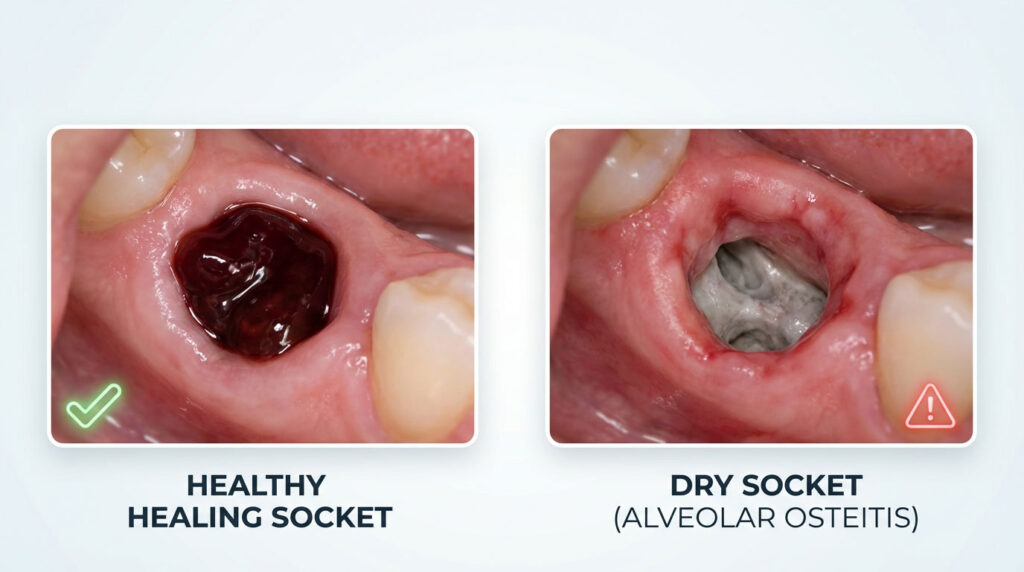
Identifying a dislodged clot visually requires good lighting. In a healthy healing scenario, looking into the mouth reveals a dark shadow or a dark scab that looks like a “filled” hole.
When the clot is effectively lost, the socket appears “empty.” You may be able to see deep into the gum tissue. The most distinct visual sign of a dislodged blood clot is the color of the socket walls; if you see dry, whitish-grey material, you are looking at exposed alveolar bone.
Dry Socket Pain Symptoms: Radiating Pain to Ear and Neck
Pain is the most accurate diagnostic tool for determining the status of your clot. Normal post-operative pain typically peaks on day 2 and gradually subsides, usually manageable with standard analgesics like Ibuprofen.
Dry socket symptoms present a different pain pattern. The pain typically begins or spikes significantly on Day 3, 4, or 5. It is a deep, throbbing ache that often resists over-the-counter medication.
The hallmark of dry socket pain is radiation. The pain rarely stays localized to the gum; instead, it travels along the trigeminal nerve, radiating to the ear, the eye, the temple, or down into the neck. If you experience a toothache that feels like an earache three days post-surgery, you likely have a dry socket.
Bad Taste and Smell Indicating Lost Blood Clot
A normally healing socket might produce a mild metallic taste due to minor bleeding; this is acceptable. A dry socket, however, traps food debris and bacteria because the protective seal is missing.
This accumulation leads to a distinct, foul odor and a terrible taste in the mouth. Patients often describe it as the smell of rotting meat or fermentation. This condition, known as halitosis, is a strong indicator that the blood clot after tooth extraction has failed and infection or dry socket is present.
Comparison Table: Normal Healing vs. Dry Socket Symptoms
| Feature | Normal Healing Socket | Dry Socket (Alveolar Osteitis) |
| Pain Intensity | Mild to moderate; decreases daily. | Severe, throbbing; spikes days 3-5. |
| Visual Appearance | Dark red scab or creamy white tissue. | “Empty” hole; visible whitish-grey bone. |
| Smell/Taste | Mild metallic (blood) or salty. | Foul, rotting odor (halitosis); bad taste. |
| Response to Meds | Managed by Ibuprofen/Tylenol. | OTC meds provide little to no relief. |
| Pain Radiation | Localized to the extraction site. | Radiates to the ear, eye, temple, or neck. |
| Swelling | Peaks day 3, then subsides. | May not be present; pain is the main issue. |
White Stuff in Extraction Hole: Granulation Tissue vs. Food Debris
Around day 3 or 4, many patients experience anxiety because the dark red clot turns white. They often assume this is pus or trapped food. In most cases, this white stuff in the socket is actually a positive indicator of healing.
What Does Granulation Tissue Look Like in a Healing Socket?
Granulation tissue is the body’s primary rebuilding material; it is composed of collagen, white blood cells, and new microscopic blood vessels. It typically appears as a creamy white, yellowish, or light pink material inside the socket.
This tissue is delicate and soft. It signifies that your body is successfully bridging the gap left by the extracted tooth. Patients must not try to clean or brush this tissue away, as disturbing granulation tissue can restart the healing process and cause fresh bleeding.
Distinguishing Healthy Tissue From Infection in the Gum
It is vital to distinguish between healthy white tissue and an active infection. An infected socket will typically be accompanied by significant swelling that worsens rather than improves.
Infection produces pus, which is a thick, yellow-green liquid that often oozes when the gum is pressed. Granulation tissue does not ooze; it is a solid, albeit soft, structure. Furthermore, infection usually presents with systemic signs like fever and swollen lymph nodes in the neck. If you have white stuff in the extraction hole but no pain and no fever, it is likely healthy healing.
How to Remove Food from Wisdom Tooth Hole Without Dislodging Clot
Food particles can easily get stuck in the extraction hole. If you see something white that looks distinct, like a grain of rice or bread, it might be debris.
The safest method to check is to perform a gentle salt water rinse. Tilt your head to the side and let the water passively roll over the socket. If the white speck washes away, it was food. If it stays firmly in place, it is likely granulation tissue or the fibrin clot evolving. Never use a toothpick, water flosser, or sharp object to dig inside the socket.
Causes of Dislodged Blood Clot and Risk Factors for Dry Socket
Understanding why a blood clot after tooth extraction fails allows you to take preventative measures. The clot is held in place only by the friction of the fibrin mesh against the bone walls; it is easily dislodged by mechanical or chemical forces.
Mechanical Disruption: Straws, Suction, and Spitting
The most frequent cause of a dislodged blood clot is negative pressure. Suction creates a vacuum environment in the mouth that can physically rip the clot out of the socket.
This is why dentists strictly forbid the use of straws for at least one week. The muscular action required to pull liquid through a straw creates immense intra-oral pressure. Similarly, the act of spitting forcefully after brushing can dislodge the clot. Vigorous rinsing is another culprit; swishing water aggressively creates turbulence that can wash the clot away before it has fully stabilized.
Impact of Smoking and Vaping on Blood Clot Retention
Smoking and vaping are the most significant antagonists to the blood clot after tooth extraction. Nicotine acts as a vasoconstrictor, meaning it narrows the blood vessels and reduces blood supply to the gum tissue. This makes it significantly harder for the clot to form and stay healthy.
Additionally, the chemicals found in smoke can chemically break down the fibrin protein, leading to the premature disintegration of the clot. The suction motion required to inhale vape or cigarette smoke further adds to the mechanical risk.
Biological Factors: Oral Contraceptives and Wisdom Tooth Extraction Risks
Systemic biological factors also play a major role. Oral contraceptives (birth control pills) containing estrogen are statistically shown to increase the risk of dry socket. Estrogen activates the fibrinolytic system, which is the body’s natural mechanism for dissolving clots. Women on birth control are nearly twice as likely to develop dry socket compared to those who are not.
The difficulty of the extraction is also a factor. A simple extraction of a front tooth rarely results in dry socket. However, wisdom teeth removal, specifically of the lower (mandibular) teeth, carries a much higher risk. The bone in the lower jaw is denser and has less blood supply than the upper jaw, making clot formation slower.
Comparison Table: Risk Factors for Dry Socket
| Risk Factor | Impact on Clot Stability | Estimated Risk Increase |
| Smoking/Vaping | Vasoconstriction; suction dislodges clot. | 3x to 4x higher risk. |
| Oral Contraceptives | Estrogen dissolves fibrin (fibrinolysis). | 2x higher risk. |
| Impacted Lower Molar | Dense bone; surgical trauma. | ~30% incidence rate. |
| Poor Oral Hygiene | Bacterial enzymes break down clot. | Moderate increase. |
| Age (Over 25) | Slower healing response. | Slight increase. |
How to Keep Blood Clot in Place: Post-Extraction Care Instructions
Protecting the blood clot after tooth extraction requires adhering to a strict protocol for the first 7 to 10 days. Here is a comprehensive strategy to ensure the clot remains secure.
Immediate Care: Gauze Pressure and Avoiding Suction (First 24 Hours)
The first day is the most critical window. You must allow the fibrin clot to establish its structural grip on the bone walls.
- Maintain Gauze Pressure: Keep firm, constant pressure on the sterile gauze pad provided by your dentist for 30 to 60 minutes. Pressure initiates hemostasis and helps the clot structure itself.
- The “Zero Suction” Rule: Do not use straws. Do not spit into the sink. If you need to empty your mouth, open wide and let the fluid drool out into a napkin or the sink.
- Head Elevation: Sleep with your head propped up on two pillows. Laying flat increases blood pressure in the cranial area, which can cause the socket to throb and bleed.
Safe Hygiene: Brushing and Salt Water Rinses After Extraction
Once the initial clot is formed, you must keep the bacteria count low without physically disturbing the wound.
- Gentle Salt Water Rinses: Starting 24 hours after surgery, mix half a teaspoon of salt in a cup of warm water. Do not swish vigorously. Tilt your head from side to side to let the water bathe the wound, then open your mouth and let the water fall out.
- Brushing Strategy: You can and should brush your teeth to reduce bacteria. However, avoid the teeth immediately adjacent to the extraction site for the first 3 days. Clean them gently with a Q-tip dipped in mouthwash or salt water if necessary.
- Avoid Alcohol Mouthwash: Do not use commercial mouthwash containing alcohol, as it can chemically dissolve the clot. Only use prescription rinses like Chlorhexidine (Peridex) if specifically instructed.
Foods to Eat and Avoid to Protect the Healing Socket
Your diet directly impacts the safety of the blood clot after tooth extraction.
- Soft Foods to Eat: Stick to yogurt, applesauce, mashed potatoes, and scrambled eggs for the first 3 days.
- Foods to Avoid: Crunchy items like chips, popcorn, nuts, and seeds are dangerous; a small shard can poke the clot and mechanically dislodge it.
- Temperature Control: Eat foods at room temperature. Extremely hot soups or coffee can increase local blood flow and cause throbbing or secondary bleeding.
Medical Interventions: Collagen Plugs and Dry Socket Paste
Modern dentistry offers specific tools to help reduce the risk of a dislodged blood clot. Your oral surgeon may have utilized these during your procedure to aid healing.
Benefits of a Collagen Plug for Tooth Extraction Healing
A collagen plug is a small, bio-absorbable sponge made from purified collagen. The surgeon inserts this into the socket immediately after the extraction.
The plug serves as a stable matrix that helps hold the blood clot after tooth extraction in place. It absorbs blood and expands to fill the space, making it much harder for the clot to fall out. It is commonly used in wisdom teeth removal or for patients taking blood thinners.
What to Do If the Collagen Plug Falls Out
Patients often panic when they spit out a mushy, white or brownish blob on day 3 or 4, assuming they have lost their clot. In many cases, this is just the remnants of the collagen plug.
As the body heals, it naturally breaks down the collagen material. The top portion of the plug may loosen and fall out. This is usually normal. If there is no severe pain and no active bleeding, the underlying fibrin clot is likely still intact underneath the dissolved plug.
Using Alvogyl and Clove Oil for Dry Socket Pain Relief
If you do develop a dry socket, home remedies are often insufficient. You usually need professional intervention. Dentists use a medicated paste or dressing, often referred to as Alvogyl.
This paste contains eugenol (extracted from clove oil), a local anesthetic (like benzocaine), and a carrier medium. When placed into the empty socket, it provides almost instant relief by soothing the exposed nerve. It does not make the clot grow back; rather, it acts as a synthetic cover while the body heals from the inside out.
Clove oil for dry socket is a well-known temporary home remedy. It contains eugenol, which has natural analgesic and antiseptic properties. However, apply it with caution; putting pure clove oil directly on the gum can cause chemical burns. Apply a tiny amount to a small piece of gauze and gently place it near the site.
Action Plan: What to Do If Blood Clot Falls Out
Panic often leads to the wrong actions. Use this decision matrix to determine your next step if you believe your blood clot after tooth extraction has been lost.
Managing a Lost Blood Clot with No Pain
You spit out a dark jelly mass or a white sponge. You look in the mirror and the hole looks deep. However, your pain level is low (1-3 out of 10) or manageable with Tylenol.
- Verdict: You are likely safe. You may have lost a piece of the “liver clot” or the top scab, but the granulation tissue deep inside is likely intact.
- Action: Do not poke the hole. Continue gentle salt water rinses to prevent infection. Monitor for any increase in pain.
Emergency Steps for Lost Clot with Severe Pain (Dry Socket)
You see an empty hole or white bone. The pain is throbbing and has increased significantly since yesterday. It is radiating to your ear or temple.
- Verdict: You have alveolar osteitis (dry socket).
- Action: Call your dentist immediately. Do not try to flush the socket out with high pressure. Take anti-inflammatory medication and wait for professional treatment with a medicated dressing.
Risks of Accidentally Swallowing the Blood Clot
You felt a slime slide down your throat and realized it was likely the clot.
- Verdict: Swallowing the clot is harmless. The acid in your stomach will digest it like any other protein. The only concern is the empty socket left behind in the mouth.
- Action: Check for pain. If there is no pain, follow the steps for “Lost Blood Clot with No Pain.” If pain begins, follow the steps for “Dry Socket.”
FAQs: Common Questions About Blood Clots and Healing
Can a blood clot reform after tooth extraction if it falls out?
No, the primary blood clot after tooth extraction will not reform once it is fully lost. The initial signaling for rapid clotting happens only immediately after the injury. If the clot is lost, the body must heal by “secondary intention,” meaning tissue grows slowly from the bottom of the socket up.
I accidentally swallowed a blood clot; is that dangerous?
It is not dangerous to your health to swallow a blood clot. Your stomach acid will break it down like any other protein. The only risk is to the extraction site, which is now exposed. If you swallowed the clot, monitor your pain levels closely for signs of dry socket.
How to sleep to keep the blood clot in place?
You should sleep with your head elevated on two or more pillows for the first 48 to 72 hours. Keeping your head above your heart reduces blood pressure in the facial area, which minimizes throbbing and creates a stable environment for the clot.
What does a blood clot look like in the mouth on Day 3?
By Day 3, a healthy clot often looks darker (maroon, black, or brownish) and may shrink slightly. You might also start to see creamy white or yellowish edges. This is granulation tissue forming. It should not look like dry, grey bone.
Blood clot fell out 3 days after tooth extraction no pain—am I okay?
Yes, you are likely okay. If you have no pain, you do not have a dry socket. You likely lost a superficial part of the clot or a liver clot, but the deep protection is still there. Continue to keep the area clean and do not disturb the socket.
Is it normal to have a jelly-like blood clot after wisdom teeth removal?
Yes, this is very common and is often called a “liver clot.” It is caused by venous blood pooling and coagulating outside the socket. As long as it is not accompanied by severe active bleeding, it is a benign part of the healing process.
How long does it take for the blood clot to be safe?
The most critical period is the first 72 to 96 hours (Days 1-4). By Day 7 to 10, the clot has usually integrated into the gum tissue or has been replaced by enough granulation tissue that the risk of the clot falling out is minimal.
Can I use clove oil for dry socket relief at home?
Yes, but with caution. Clove oil for dry socket contains eugenol, which is a natural anesthetic. Place a drop on a small piece of gauze and gently set it near the socket. Do not pour oil directly into the socket or on the gum, as it can cause tissue burns.
Does losing the blood clot guarantee a dry socket?
No. If the clot falls out after day 4 or 5, the socket may have already healed enough to cover the bone. Dry socket is defined by the pain and exposed bone, not just the absence of the initial clot. If you are pain-free, you do not have a clinically significant dry socket.
How do I clean food out of the wisdom tooth hole without dislodging the clot?
Do not use a toothpick, water flosser, or toothbrush inside the hole. Use a gentle lukewarm salt water rinse. Tilt your head to let the water roll over the hole. If the food does not come out, leave it. Your body will eventually push it out as the socket heals.
Disclaimer
The content provided in this article is for informational purposes only and does not constitute medical advice. Every patient’s recovery is unique. If you experience severe pain, heavy bleeding, or signs of infection (fever, swelling), contact your dentist or oral surgeon immediately.
References
- American Dental Association (ADA). “Dry Socket.” MouthHealthy.org.
- Mayo Clinic. “Dry socket – Symptoms and causes.”
- Journal of the American Dental Association (JADA). Studies on Alveolar Osteitis risk factors and treatments.
- National Institutes of Health (NIH). Research on fibrinolysis and oral contraceptives in dental extraction.